

Affiliate tracking is defined as the technology and process that identifies which affiliates drive conversions, enabling brands to pay commissions accurately and optimize partnerships based on real performance data. The role of tracking in affiliate marketing goes far beyond logging clicks. It determines budget allocation, shapes partner trust, and separates programs that scale from programs that stall. Tools like Cometly, Track360, and platforms managed by PartnerLlama all depend on tracking accuracy as the foundation of every decision. Without it, you are paying commissions on guesswork.
How does affiliate tracking work and what technologies power it?
Affiliate tracking works by assigning a unique click ID to every link a partner shares. When a user clicks that link, the ID travels with them through the funnel. When a conversion fires, the platform matches the click ID to the original affiliate and records the event.
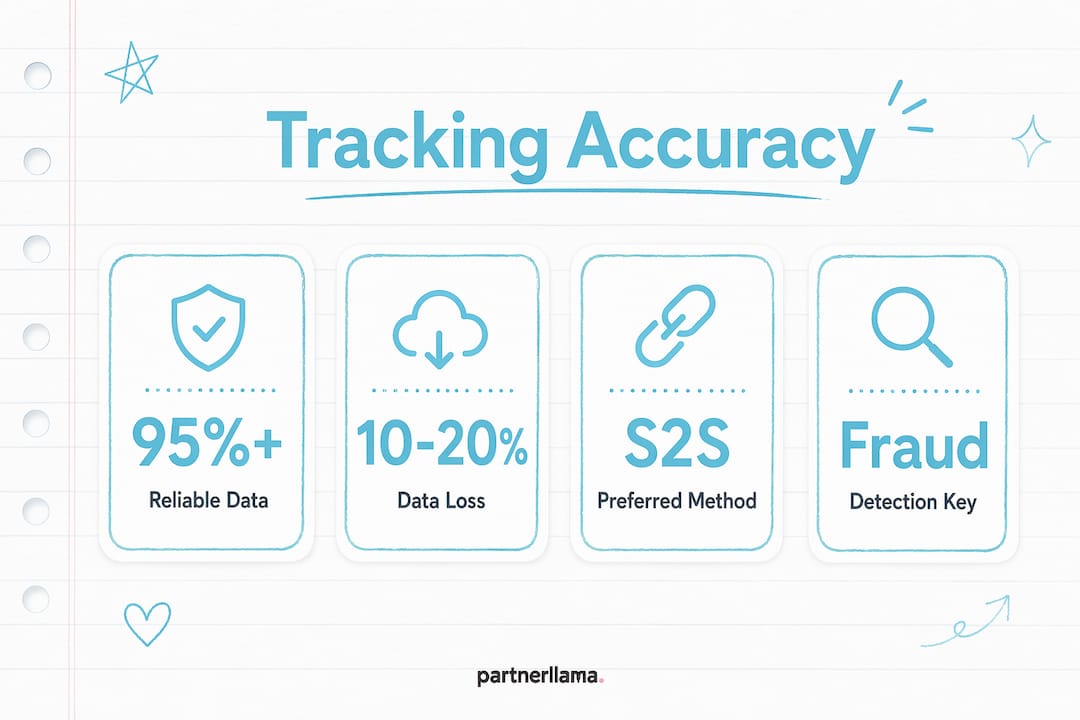
Cookie and pixel tracking was the standard method for years. A small file is stored in the user's browser at the moment of the click, then read again at conversion. The problem is that browsers like Safari and Firefox now block or expire third-party cookies aggressively. That restriction causes 10–20% data loss in cookie-based programs. That is not a rounding error. It is real revenue misattributed or lost entirely.

Server-to-server (S2S) postback tracking solves this. Instead of relying on the browser, the affiliate platform and the advertiser's server communicate directly. No browser is involved, so no browser restriction applies. S2S tracking also captures deep-funnel events like subscription renewals or funded accounts that happen days after the initial click, which cookie methods routinely miss.
Sub-ID management adds another layer of precision. Sub-IDs are parameters appended to affiliate links that identify the specific traffic source, creative, or placement behind each click. Reliable sub-ID pass-through lets affiliates see exactly which placements convert, so they can shift spend toward what works. Platforms that truncate or drop sub-IDs blind affiliates to their own performance data, which increases churn.
| Method | Accuracy | Deep-funnel events | Browser dependency |
|---|---|---|---|
| Cookie/pixel tracking | Below 70% | No | High |
| Server-to-server (S2S) | 95%+ | Yes | None |
Pro Tip: Build your tracking stack around S2S postbacks from day one. Retrofitting a cookie-based program to S2S after scaling is far more disruptive than setting it up correctly at launch.
Why does tracking accuracy matter for affiliate program success?
Tracking accuracy is the difference between a program you can trust and one you can only guess at. Achieving 95%+ tracking accuracy is the standard for high-performance affiliate programs. The gap between 70% and 95% coverage is decisive for budget allocation and optimization. At 70%, you are misattributing roughly three in ten conversions. At 95%, your data is reliable enough to make real decisions.
Inaccurate tracking creates commission disputes. When affiliates believe they drove a sale but the platform shows no record of it, trust erodes fast. Accurate, real-time tracking builds partner trust, reduces disputes, and directly improves affiliate retention. Partners who trust your reporting stay in your program longer and promote you more aggressively.
Fraud reduction is another direct benefit. Paying commissions on registrations or shallow top-of-funnel events invites abuse. Fake sign-ups are cheap to generate. Deep-funnel event tracking ties affiliate payments to real business outcomes like funded accounts, completed purchases, or active subscriptions. That alignment removes the financial incentive for fraud.
"Tracking is the engine of partner trust. Accurate real-time reporting ensures correct payments and higher affiliate retention." — Affiliate tracking software insights
Long-term program growth depends on this accuracy. Brands that can show affiliates exactly what they earned, and why, build the kind of transparent relationships that attract top-tier partners. Top partners have options. They choose programs where the numbers make sense.
What are the challenges in affiliate tracking today?
Browser privacy changes are the most immediate challenge. Apple's Intelligent Tracking Prevention and Firefox's Enhanced Tracking Protection have shortened cookie lifespans and blocked third-party data collection. Any program still relying primarily on pixel or cookie tracking is losing data every day.
Attribution model limitations run a close second. Most programs default to last-click attribution, meaning the final affiliate to touch a customer before conversion gets full credit. That model ignores every other partner who influenced the decision. Multi-touch attribution integrates affiliate data with CRM and paid media to distribute credit across all contributors in the conversion path. It is more complex to implement, but it reflects how customers actually behave.
Data integration creates friction for larger programs. Connecting your affiliate platform to your CRM, your paid media dashboards, and your analytics stack requires technical work. Without that integration, you end up with siloed data that tells incomplete stories. A content affiliate might look underperforming in last-click reports but drive significant first-touch volume that paid search later closes.
Common tracking challenges marketing teams face:
- Cookie deprecation reducing coverage in Safari and Firefox environments
- Last-click attribution underpaying top-of-funnel and mid-funnel affiliates
- Sub-ID truncation hiding traffic source quality from affiliates
- Manual tracking processes creating commission errors at scale
- Fraud from shallow event tracking such as registrations or email submissions
- CRM and paid media data living in separate systems from affiliate data
Pro Tip: Layer a fraud detection system directly on top of your tracking setup. Flag any affiliate generating high registration volume with low downstream conversion rates. That pattern almost always signals incentivized or fake traffic.
How can you use tracking data to improve affiliate sales?
Tracking data is only valuable if you act on it. The first step is using performance data to evaluate partners objectively. Clicks and impressions tell you reach. Conversion rate, average order value, and customer lifetime value tell you quality. Affiliate programs without automated tracking face commission disputes and manual errors that compound as programs grow. Automation removes that friction and makes the data reliable enough to act on.
A practical optimization workflow looks like this:
- Audit your tracking setup. Confirm S2S postbacks are firing correctly for every conversion event, including deep-funnel events like renewals and upsells. Check your affiliate marketing funnel for gaps where conversions may go untracked.
- Segment affiliates by traffic quality. Use sub-ID data to identify which placements, content types, and audiences drive customers with high lifetime value, not just high volume.
- Reallocate budget toward proven performers. Shift commission rates or bonuses toward affiliates whose tracked data shows strong downstream value. Reduce spend on partners generating volume without quality.
- Build transparent reporting dashboards. Give affiliates access to their own performance data in real time. Transparency reduces disputes and motivates partners to improve.
- Automate commission calculations. Manual spreadsheet management works for one or two partners. Beyond that, errors accumulate and disputes follow. Automated platforms eliminate that risk.
Sub-ID optimization deserves special attention. When affiliates can see which of their placements convert, they shift their own effort toward better traffic. That benefits both sides. Sub-ID management is often underestimated, but it is one of the highest-leverage improvements a program can make without changing a single creative.
Reporting transparency also functions as a retention tool. Affiliates who can log in and see their numbers without emailing your team stay engaged longer. Pair that with audience alignment strategy and your tracking data becomes a tool for recruiting better partners, not just managing existing ones.
Key Takeaways
Tracking accuracy is the single most important factor separating high-performing affiliate programs from stagnant ones. Without it, every other program decision is built on unreliable data.
| Point | Details |
|---|---|
| S2S tracking is the standard | Server-to-server postbacks eliminate browser data loss and capture deep-funnel events cookie tracking misses. |
| 95% accuracy is the target | The gap between 70% and 95% tracking coverage directly affects budget decisions and partner payments. |
| Fraud requires deep-funnel events | Paying on registrations invites abuse; tie commissions to funded accounts or active subscriptions instead. |
| Sub-ID data drives optimization | Affiliates who see placement-level data shift effort toward higher-quality traffic, benefiting both sides. |
| Attribution must go beyond last-click | Multi-touch attribution credits all partners in the conversion path and reflects real customer behavior. |
Why I think most brands underinvest in tracking until it hurts them
Most brands treat tracking as a technical checkbox. They set it up once, confirm clicks are logging, and move on. That approach works until the program grows, fraud appears, or a top affiliate disputes a commission. Then the gaps become expensive.
The shift I see in mature programs is treating tracking as a business intelligence layer, not just a payment mechanism. The brands that get the most from their affiliate programs are the ones reading sub-ID data weekly, connecting affiliate performance to CRM lifetime value, and adjusting attribution models as the program evolves. They are not waiting for disputes to surface problems.
The privacy landscape is also accelerating the urgency. Cookie deprecation is not a future concern. It is already reducing data quality in programs that have not migrated to S2S. The brands that made that move two years ago are now operating with cleaner data than competitors who delayed. That gap compounds over time.
The attribution conversation is the one I find most underrated. Last-click attribution is intuitive and easy to explain, but it systematically underpays content affiliates, comparison sites, and top-of-funnel partners who do real work. When those partners feel undervalued, they deprioritize your program. Multi-touch attribution is harder to implement, but it reflects reality. Programs that reward the full conversion path attract better partners and retain them longer.
Tracking is not glamorous. But it is the foundation every other program decision rests on. Get it right early, and everything else gets easier.
— Isabel
How PartnerLlama builds programs on tracking that actually works

PartnerLlama builds affiliate programs with server-side tracking, full sub-ID management, and deep-funnel event capture built in from the start. Every program includes automated commission calculation, real-time reporting dashboards for partners, and fraud detection tied to downstream conversion events rather than shallow registrations. The result is a program your affiliates trust and your finance team can verify. If your current program is generating disputes, losing data to browser restrictions, or paying commissions on traffic that never converts, PartnerLlama's affiliate marketing management service is built to fix exactly that.
FAQ
What is the role of tracking in affiliate marketing?
Affiliate tracking identifies which partners drive conversions and revenue, enabling accurate commission payments and data-driven program optimization. Without it, brands cannot distinguish high-value affiliates from low-quality traffic sources.
Why is server-to-server tracking better than cookie tracking?
S2S postback tracking bypasses browser privacy restrictions that cause 10–20% data loss in cookie-based programs and captures deep-funnel events like renewals that cookies miss entirely.
What tracking metrics should affiliates and brands monitor?
The most important metrics are conversion rate, average order value, customer lifetime value by affiliate, and sub-ID level performance data. Clicks and impressions alone do not indicate traffic quality.
How does tracking help reduce affiliate fraud?
Tracking deep-funnel events like funded accounts or active subscriptions ties commission payments to real business outcomes. That removes the financial incentive for fake registrations and incentivized sign-ups.
What is multi-touch attribution in affiliate marketing?
Multi-touch attribution distributes conversion credit across every affiliate that influenced a customer's journey, rather than awarding all credit to the last click. It produces fairer payments and better reflects actual partner contribution.