

Affiliate marketing is defined as a performance-based channel where third-party partners promote your products and earn a commission for every sale, lead, or action they generate. The role of affiliates in online marketing has grown from a fringe tactic into a core revenue driver. U.S. affiliate spending is projected to reach $13.81 billion in 2026. That number reflects a fundamental shift: brands are treating affiliate programs with the same precision they apply to paid search. Networks like CJ, Awin, and Partnerize now manage thousands of partnerships across bloggers, influencers, coupon sites, and cashback platforms.
How do affiliates function as performance partners in online marketing?
Affiliate marketing operates as a performance-based distribution channel where external partners promote products through their own trusted content, capturing buyers at high-intent moments without any upfront media spend. The brand pays only when a desired action occurs. That structure makes affiliates fundamentally different from display advertising or sponsored posts.
Affiliates are independent operators. They own their audience, their content, and their promotional strategy. A tech blogger reviewing SaaS tools, a YouTube creator comparing fitness supplements, and a cashback site offering discount codes are all affiliates. Each one invests in SEO, email marketing, and content production independently. The brand benefits from that investment without funding it directly.

Tracking works through affiliate networks or in-house software. When a user clicks an affiliate link, a cookie or server-side token records the referral. If that user converts, the network attributes the sale and triggers a commission payment. The mechanics are straightforward. The complexity lives in attribution, which is covered in detail later.
Here is a breakdown of the most common affiliate types and how they generate sales:
- Content creators and bloggers publish product reviews, comparison articles, and buying guides that rank in Google and increasingly surface in AI-generated answers
- Coupon and deal sites capture price-sensitive buyers at the final decision stage, often intercepting sales that would have happened anyway
- Cashback platforms like Rakuten reward repeat purchases and attract loyalty-driven shoppers
- Influencers and social creators drive discovery-stage awareness and convert engaged audiences through authentic recommendations
- Email newsletter publishers reach segmented, high-intent subscribers with curated product recommendations
The pay-for-performance model is the defining advantage. You scale reach without scaling headcount. A brand running 500 active affiliates is effectively operating 500 independent sales channels, each funded only on results.
What strategic benefits do affiliates provide to brand marketers?
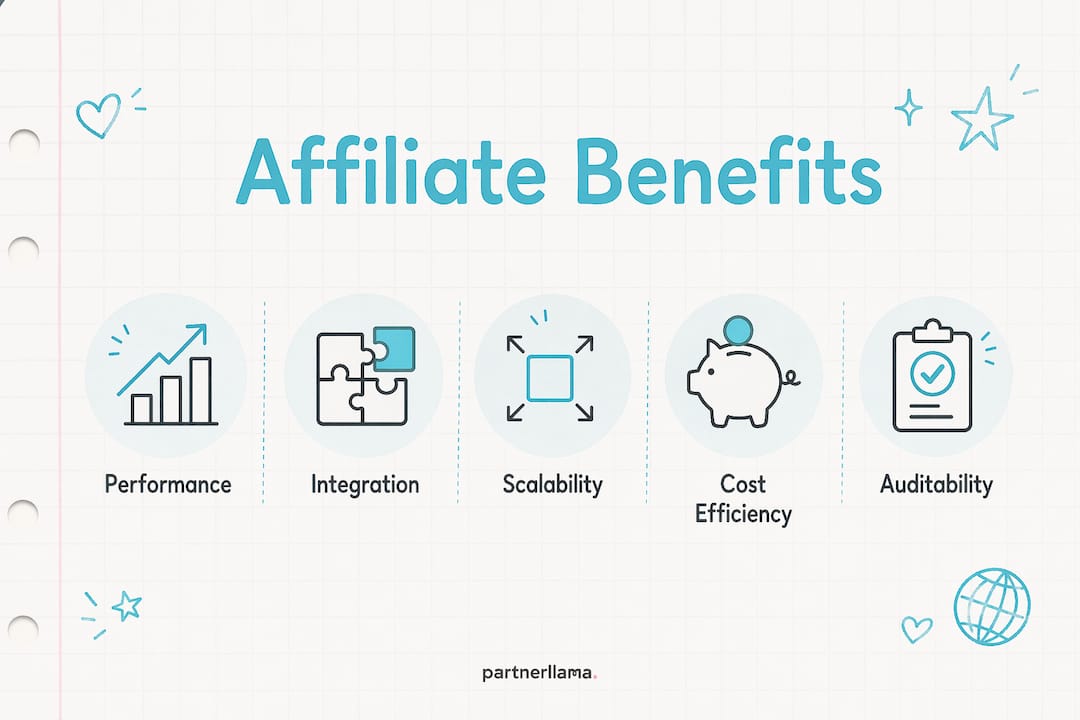
Affiliate programs contribute 15–25% of revenue at a cost-per-acquisition that frequently beats paid social and Google combined. That margin advantage becomes critical when Meta and Google CPMs rise. Affiliates absorb the media cost themselves and get paid only when they deliver.
The benefits of affiliate partnerships extend well beyond cost efficiency. Here are the four most significant strategic advantages:
- Extended reach into niche audiences. A fitness brand partnering with 50 micro-influencers and specialist blogs reaches audiences that no paid campaign could target as precisely. Each affiliate brings a pre-built, trusted relationship with their readers or followers.
- SEO and AI-driven discovery. Approximately 70% of sites cited in AI chatbot responses come from affiliate marketing content. Product reviews and shopping guides written by affiliates now appear inside ChatGPT, Perplexity, and Google's AI Overviews. Your affiliates are building your discoverability in channels you cannot buy directly.
- Incremental customer acquisition. Affiliates capture buyers at the discovery and consideration stages, not just at checkout. A well-structured program generates new customers who would never have found your brand through paid search alone.
- Credibility through trusted voices. Top affiliates behave like sales operators who understand customer objections deeply. Their recommendations carry more weight than brand-owned advertising because readers trust them as independent sources.
The combination of integrated marketing strategy and affiliate execution creates a compounding effect. Affiliate content builds organic traffic, earns AI citations, and converts buyers across the full funnel simultaneously.
Pro Tip: If paid social is eating your margins, run a 90-day affiliate pilot targeting mid-funnel content creators in your category. Measure cost-per-acquisition against your Meta campaigns. Most brands are surprised by how competitive the numbers are.
How do you measure affiliate effectiveness beyond last-click attribution?
Last-click attribution is the default setting for most affiliate programs. It is also the most misleading one. Under last-click, a coupon site that drops a discount code at the final checkout step gets full credit for a sale the content creator drove three weeks earlier. You end up overpaying partners who intercept sales and underpaying the ones who actually create demand.
Incrementality audits solve this problem directly. An incrementality audit compares sales that genuinely resulted from affiliate influence against sales that would have occurred regardless. Incrementality audits can reveal up to 3,700% performance improvement opportunities by identifying which partners drive real growth versus which ones simply claim credit. That is not a rounding error. It is a complete reallocation of your affiliate budget.
The table below shows how different attribution models treat the same affiliate sale differently:
| Attribution model | Who gets credit | Risk |
|---|---|---|
| Last-click | Final touchpoint only | Overpays coupon and cashback sites |
| First-click | First touchpoint only | Ignores conversion-stage partners |
| Linear | All touchpoints equally | Dilutes high-impact partners |
| Incrementality-based | Partners who drove new demand | Requires audit infrastructure |
Modern programs also need to integrate with commerce platforms like Amazon storefronts, TikTok Shop, and Walmart Connect. A significant share of U.S. consumers start product research on Amazon, not Google. If your affiliate program only tracks clicks from a traditional network, you are missing a large portion of the conversion journey.
Anti-fraud monitoring belongs in the same conversation. Click stuffing, cookie dropping, and fake leads are real problems in high-volume programs. Platforms like Impact and PartnerStack include fraud detection tools, but active human oversight remains the most reliable defense.
What are best practices for managing affiliate partnerships and recruitment?
Affiliate program management is the highest-leverage activity in the entire channel. Dedicated affiliate managers conducting outreach, relationship management, and content support unlock more revenue than any platform upgrade. The role is the single most important investment you can make in a growing program.
Recruitment strategy determines program quality from day one. Affiliate recruitment works best when you match partners to your product type, audience behavior, and buying cycle. YouTube creators outperform bloggers for developer tools. Long-form review blogs outperform social creators for subscription products. Matching the affiliate format to the purchase decision is the core logic of a strong recruitment strategy.
Here is what separates high-performing programs from stagnant ones:
- Treat top affiliates as creative collaborators. Share upcoming product launches, offer exclusive discount codes, and invite them into campaign planning. Partners who feel invested in your brand produce better content.
- Supply quality creative assets. Banners, product feeds, comparison tables, and video clips reduce the production burden on affiliates and keep brand presentation consistent. Active program management drives results. Set-and-forget programs underperform every time.
- Set fair commercial terms. Commission rates that are too low attract low-quality partners. Rates calibrated to lifetime customer value attract serious operators who invest in promotion.
- Monitor compliance continuously. Affiliates bidding on your brand keywords, misrepresenting your product, or using unauthorized creative can damage brand equity. Automated monitoring tools catch violations before they compound.
- Amplify top affiliate content with paid spend. A high-converting review article from a trusted affiliate can be boosted through paid social to extend its reach without creating new content from scratch.
Pro Tip: Before recruiting broadly, audit your existing affiliate base. Most programs have 20% of partners generating 80% of revenue. Understand what those top partners have in common before you recruit 100 more.
For brands building from the ground up, the influencer-affiliate hybrid model is worth serious consideration. It combines the reach and trust of influencer content with the accountability of performance-based payment.
Key takeaways
Affiliates are the most cost-efficient performance channel available to brand marketers in 2026, but only when programs are actively managed, properly measured, and built around partner quality rather than partner volume.
| Point | Details |
|---|---|
| Performance-based model | Brands pay only for results, making affiliates a margin-friendly alternative to paid social. |
| AI-driven content value | Affiliate reviews and guides now surface in ChatGPT and Perplexity, creating organic discovery at scale. |
| Attribution accuracy | Incrementality audits reallocate budget toward partners who create demand, not just claim credit. |
| Recruitment quality | Match affiliate type to product category and buying cycle for measurably better program performance. |
| Active management wins | Dedicated affiliate managers and ongoing creative support consistently outperform automated programs. |
Why affiliates are no longer optional for serious growth brands
I have watched brands treat affiliate marketing as an afterthought for years, something to set up on CJ or Awin, assign to a junior coordinator, and check quarterly. That approach produces mediocre results and reinforces the false belief that the channel does not work. The channel works. The management does not.
What changed my perspective was watching a mid-size DTC brand reallocate 30% of its Meta budget into affiliate program management and creator partnerships. Within two quarters, their cost-per-acquisition dropped and their new customer rate from affiliate traffic exceeded what paid social had delivered. The difference was not the channel. It was the commitment to running it properly.
The blend of traditional affiliates and creator-driven content is where the real opportunity sits right now. Creators who operate on a performance basis bring audience trust and content quality that brand-owned advertising cannot replicate. When you combine that with proper attribution and active management, you get a channel that compounds over time. Paid social stops the moment you stop paying. Good affiliate content keeps converting for months or years.
The brands ignoring this are not saving money. They are leaving growth on the table while their competitors build affiliate programs that will be very hard to catch up to. Affiliate marketing is not a shortcut. It is a system. Build it like one.
— Isabel
Build a program that actually performs with PartnerLlama
If your affiliate program is underperforming or you are starting from scratch, the gap is almost always in execution, not strategy.

PartnerLlama manages the full affiliate partner lifecycle for SaaS, DTC, and ecommerce brands. From affiliate program management and recruitment to commission structures and partner retention, every program is built around your specific business model and growth stage. PartnerLlama also provides lifecycle email marketing designed specifically for affiliate and partner traffic, turning referred visitors into long-term customers. If you are ready to turn your affiliate channel into a scalable revenue system, PartnerLlama is built for exactly that.
FAQ
What is the role of affiliates in online marketing?
Affiliates are third-party partners who promote a brand's products through their own content and audiences, earning a commission for each sale or lead they generate. They function as independent performance channels that extend brand reach without upfront media spend.
How do affiliates drive sales for brands?
Affiliates drive sales by publishing product reviews, comparison guides, coupon offers, and social content that captures buyers at high-intent moments. They invest in their own SEO and audience-building, delivering conversions the brand pays for only after they occur.
What is the best way to measure affiliate marketing effectiveness?
Incrementality audits are the most accurate measurement approach, identifying which affiliates drive genuinely new demand versus intercepting sales that would have happened anyway. Last-click attribution alone consistently overpays coupon and cashback partners.
How does affiliate recruitment strategy affect program performance?
Matching affiliates to your product type, audience behavior, and buying cycle determines program quality from the start. YouTube creators perform better for developer tools, while long-form review blogs outperform for subscription products.
How do affiliates fit into an integrated marketing strategy?
Affiliates complement paid search, social, and email by covering the discovery and consideration stages of the funnel. Their content also surfaces in AI-driven search results, extending brand visibility into channels that cannot be bought directly.