

An affiliate program is a partnership-based referral system where external promoters earn a commission for every sale, lead, or action they drive to your business. Starting an affiliate program from scratch explained properly means understanding three core components before you write a single line of code or recruit a single partner: commission structures, tracking technology, and partner management. Get those three right, and you have a scalable sales channel that grows without proportional increases in your marketing budget. Get them wrong, and you have disputes, unpaid affiliates, and wasted traffic.
What are the foundational steps to build an affiliate program from scratch?
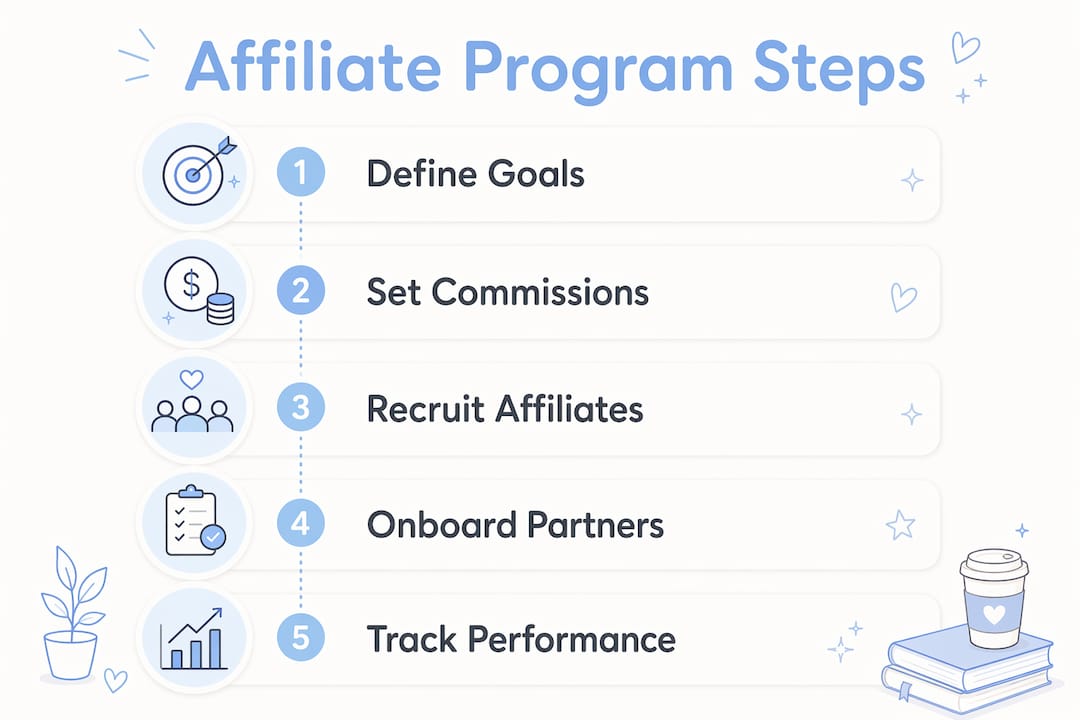
Building an affiliate program starts with defining what success looks like before you choose any tools. Set specific targets: a target cost per acquisition, a minimum monthly revenue contribution from affiliates, and a target number of active partners within 90 days. Without these numbers, you cannot evaluate whether your commission structure is sustainable or whether your program is actually growing.
Commission structure is the most consequential early decision you will make. Commissions typically range from 5% to 30%, varying by product type and profit margins, with tiered structures used to motivate top performers. A 5% flat rate on a $20 product gives affiliates $1 per sale. That will not attract serious content creators. Map your margins first, then work backward to a commission that is attractive enough to recruit quality partners while protecting your profitability.

Next, choose your affiliate tracking software. Platforms like Impact, PartnerStack, Rewardful, and Tapfiliate each handle link generation, click tracking, and commission calculation differently. Your choice depends on your tech stack, budget, and whether you need self-serve affiliate applications or a managed recruitment workflow. Automated payout and rewards tracking software reduces errors and improves affiliate satisfaction, which directly affects retention.
Payment terms are a detail many first-time program operators underestimate. Typical payment schedules are net-30 or net-60, paid after sale confirmation to allow time for returns and chargebacks to process. Communicate these terms clearly in your program documentation before any affiliate joins. Surprises in payment timing are one of the fastest ways to lose good partners.
-
Define measurable program goals before selecting tools or setting commissions
-
Set commission rates based on your actual profit margins, not industry averages
-
Choose tracking software that matches your technical infrastructure
-
Establish net-30 or net-60 payment terms and document them clearly
-
Draft affiliate terms and conditions covering promotional rules, disclosure requirements, and eligibility
Pro Tip: Run a simple break-even analysis before finalizing your commission rate. Calculate the maximum commission you can pay while still hitting your target margin, then set your rate 3 to 5 percentage points below that ceiling. This gives you room to offer performance bonuses without restructuring your entire program.
How do you recruit, vet, and onboard affiliates effectively?
Affiliate recruitment is not a numbers game. One hundred low-quality affiliates with misaligned audiences will generate less revenue than ten well-matched creators with engaged followings. Combining proactive outreach with open applications produces the best partner quality because it gives you both control and scale.
Proactive outreach means identifying creators, bloggers, and niche publishers whose audiences already buy products like yours. Search for content that ranks for your target keywords, look at who is already reviewing competitors, and check which influencers your existing customers follow. These are warm prospects because their audience is pre-qualified. Open applications work as a complement, not a replacement, because they surface partners you would never find through manual research.
Vetting criteria should focus on audience alignment and engagement quality, not follower count. A micro-influencer with 8,000 highly engaged followers in your exact niche will outperform a general lifestyle creator with 200,000 passive followers. Ask applicants for their website URL, primary content topics, and audience demographics. Review their recent content for brand safety before approving anyone.
Onboarding is where most programs lose momentum. Structured onboarding with brand guidelines, messaging, and ready-to-use assets accelerates activation because affiliates do not have to figure out how to promote you. The faster an affiliate makes their first sale, the more likely they are to stay active.
Here is a practical onboarding sequence that works:
-
Send a welcome email with their unique affiliate link, login credentials, and a one-page program overview
-
Provide a brand asset folder containing logos, product images, approved copy, and prohibited phrases
-
Share a short FAQ document covering commission rates, payment schedule, and how to read their dashboard
-
Schedule a brief check-in call or send a video walkthrough for high-value recruits
-
Set a 30-day activation goal and follow up with anyone who has not made their first referral
Pro Tip: Create a “first sale” incentive specifically for new affiliates. A small bonus for generating a sale within the first 30 days costs very little but dramatically increases activation rates. Affiliates who make one sale almost always try to make a second.
For influencer affiliate programs, the onboarding process should also include content guidelines and example posts so creators understand exactly what kind of content performs well for your brand.
What are the technical and tracking essentials for running a smooth program?
Affiliate tracking is the infrastructure your entire program runs on. If attribution breaks, affiliates do not get paid for sales they drove, disputes follow, and trust collapses. Understanding how tracking works prevents these failures.
The standard mechanism uses cookie-based attribution. When a visitor clicks an affiliate link, a cookie is stored in their browser containing the affiliate’s unique identifier. If that visitor completes a purchase within the cookie window, the sale is credited to that affiliate. Affiliate tracking uses referral link cookies, coupon codes, and server-side tracking to credit affiliates accurately, with server-side backup handling cases where browser privacy settings block first-party cookies.
Cookie duration directly affects how many conversions get credited. Typical cookie durations are 30, 60, or 90 days depending on the length of the purchase cycle. A 30-day window suits impulse purchases. A 90-day window suits considered purchases like software subscriptions or electronics, where buyers research for weeks before committing. Misaligning your cookie window with your actual sales cycle means affiliates lose credit for conversions they legitimately influenced.
| Tracking method | Best use case | Key limitation |
|---|---|---|
| Cookie-based links | Standard e-commerce and SaaS | Blocked by some browsers and ad blockers |
| Coupon codes | Influencer and social media campaigns | Cannot track browsing behavior, only redemptions |
| Server-side tracking | High-privacy environments, iOS users | Requires developer setup and maintenance |
For technical implementation, capturing referral parameters and persisting them through checkout via cookies and metadata is the clean approach used in modern stacks. This means when a user lands on your site with a "?ref=affiliatename` parameter, that value is stored in a cookie and passed to your payment processor at checkout so the attribution is recorded server-side regardless of browser behavior.
Testing affiliate tracking end-to-end before launch prevents major issues and affiliate complaints after launch. Run test purchases through every affiliate link type you plan to use, verify the commission appears in the dashboard, and confirm the payout calculation is correct. This takes two hours and saves weeks of dispute resolution.
Pro Tip: Always test your tracking in incognito mode and on a mobile device. Many tracking failures only appear in privacy-restricted environments, which is exactly where a large portion of your real traffic will come from.
For commission and payout management, automated systems that trigger payments on schedule remove the manual workload and eliminate the most common source of affiliate complaints.
How to handle legal compliance and program governance
Affiliate terms and conditions are not a formality. They are the legal framework that defines what affiliates can and cannot do when promoting your brand, and they protect you when disputes arise.
Affiliate terms should clearly cover commission structure, cookie duration, promotional rules, eligibility, refund handling, and termination. Each of these elements prevents a specific category of dispute. Vague refund handling language, for example, leads to affiliates demanding commissions on returned orders. Clear termination clauses let you remove bad actors without legal exposure.
FTC guidelines require affiliates to disclose their relationship with your brand whenever they promote your products. This means every blog post, social media caption, and video that includes an affiliate link must contain a clear disclosure statement. Your terms and conditions must require this disclosure explicitly, and your onboarding materials should explain what compliant disclosure looks like in practice.
Key components your affiliate agreement must include:
-
Commission calculation method and the events that trigger a commission
-
Cookie duration and how last-click attribution is applied
-
Prohibited promotional tactics, including paid search bidding on your brand name
-
Refund and chargeback policy and how they affect commission eligibility
-
FTC disclosure requirements and examples of compliant language
-
Process for updating terms and the notice period affiliates receive before changes take effect
Require affiliates to actively accept your terms during registration, not just check a box. A logged acceptance with a timestamp is your evidence if a dispute reaches a legal threshold. Build this into your registration flow from day one.
What are common pitfalls when scaling an affiliate program?
Most affiliate programs plateau not because they lack affiliates but because they track the wrong metrics. Clicks and impressions tell you about reach. Conversions and revenue per affiliate tell you about performance. Focusing on conversion tracking in addition to clicks early on is how you accurately optimize affiliate marketing efforts for maximum return.
Cookie window misalignment is the most common technical mistake in programs that have been running for six months or more. If your average customer takes 45 days from first click to purchase and your cookie window is 30 days, you are systematically under-crediting your affiliates. Aligning cookie duration to the real customer purchase cycle avoids under-crediting affiliate conversions that happen after delayed decisions.
-
Audit your attribution data quarterly to catch tracking drift before it causes disputes
-
Use tiered commission structures to reward your top 10% of affiliates without raising base rates for everyone
-
Run time-bound promotions with higher commissions to re-engage dormant affiliates
-
Avoid relying entirely on automation. Personal check-ins with top affiliates generate loyalty that no software can replicate
-
Monitor for coupon code leakage, where affiliates share codes on deal sites outside your approved channels
Pro Tip: Segment your affiliate roster into tiers based on 90-day revenue contribution. Spend 80% of your relationship management time on the top tier. The bottom tier should be handled through automated email sequences, not manual outreach.
The lifecycle marketing approach applies directly here. Treating affiliates like customers, with onboarding sequences, re-engagement campaigns, and loyalty incentives, produces measurably better retention than treating them as a passive distribution channel.
Key takeaways
A successful affiliate program requires aligned commission structures, reliable tracking infrastructure, and active partner management from day one.
| Point | Details |
|---|---|
| Set goals before tools | Define cost per acquisition and revenue targets before selecting tracking software. |
| Match commissions to margins | Calculate your break-even commission rate and set rates below that ceiling to allow for bonuses. |
| Test tracking before launch | Run end-to-end test purchases across all link types to catch attribution errors before affiliates join. |
| Align cookie windows to sales cycles | Use 30-day windows for impulse buys and 90-day windows for considered purchases to credit affiliates fairly. |
| Govern with clear terms | Require active acceptance of affiliate terms covering commissions, refunds, disclosures, and prohibited promotions. |
What I’ve learned from building affiliate programs from the ground up
The part nobody tells you about starting an affiliate program from scratch is how much of the early work is invisible to affiliates. You spend weeks configuring tracking, writing terms, testing payment flows, and building asset libraries before a single partner ever logs in. That groundwork determines whether your program earns a reputation as reliable or unreliable within the first 90 days.
The single most overlooked step I see is pre-launch tracking validation. Operators rush to recruit affiliates before confirming that their attribution system actually works under real conditions. The first disputed commission is always more expensive than the two hours it takes to run proper end-to-end tests.
I also think the industry overcomplicates recruitment. You do not need 500 affiliates. You need 20 affiliates who genuinely believe in your product and have audiences that match your buyer profile. Start small, learn what content and channels convert, and then scale what works. Programs that recruit aggressively before they understand their conversion data almost always end up with bloated rosters and thin results.
Technology has made the operational side of affiliate management far more manageable than it was five years ago. Automated payouts, real-time dashboards, and server-side tracking have removed most of the manual friction. The competitive advantage now sits in relationship quality and program design, not in who has the most sophisticated tech stack.
— Isabel
How Partnerllama helps you scale your affiliate program faster
Building a program from scratch takes time, and the operational complexity compounds quickly once you have active affiliates generating sales. Partnerllama handles the full cycle, from tracking setup and commission management to partner recruitment and activation, so you can focus on your product instead of your program infrastructure.

Partnerllama’s affiliate marketing management covers automated tracking, rewards management, and partner recruitment for DTC and SaaS brands. For operators who need reliable, dispute-free payouts, the commission and payout management system automates payment schedules and handles the attribution logic that causes most affiliate complaints. If you are ready to build a program that generates measurable revenue from day one, Partnerllama is built for exactly that.
FAQ
What is an affiliate program?
An affiliate program is a referral-based marketing system where partners earn a commission for driving sales, leads, or other defined actions to a business. The business provides unique tracking links, and commissions are paid after confirmed conversions.
How much should I pay affiliates in commissions?
Commission rates typically range from 5% to 30% depending on product category and profit margins. Calculate your maximum sustainable rate based on your margins, then set your base rate below that ceiling to leave room for performance bonuses.
How long should my affiliate cookie window be?
Cookie durations of 30, 60, or 90 days are standard, and the right choice depends on your average sales cycle. Use 30 days for fast-moving consumer products and 60 to 90 days for higher-consideration purchases where buyers research before committing.
Do affiliates need to disclose their relationship with my brand?
Yes. FTC guidelines require affiliates to clearly disclose their commercial relationship whenever they promote your products. Your affiliate terms and conditions must mandate this disclosure, and your onboarding materials should provide compliant example language.
When should I test my affiliate tracking system?
Test affiliate tracking end-to-end before recruiting any affiliates. Run test purchases through every link type you plan to use, verify commission calculations, and test in incognito mode and on mobile to catch privacy-related attribution failures before they affect real partners.