

A SaaS referral program rewards existing customers for recommending your product to peers, while an affiliate program compensates external marketers for driving traffic and conversions. These two models are often confused, but the differences in who promotes, why they promote, and how you pay them shape everything from program design to long-term ROI. Getting the SaaS referral vs affiliate explained correctly is not a semantic exercise. It determines your cost structure, lead quality, and how much operational overhead you take on. Both programs belong in a mature growth strategy, but they serve different purposes and require different management.
What are the main operational differences between SaaS referral and affiliate programs?
Referral programs and affiliate programs differ at the source: who is doing the promoting. Referral promoters are your existing customers. They recommend your product because they use it and trust it. Affiliates are external marketers, content creators, or media publishers who promote your product for a commission, often without ever using it themselves.

That difference in motivation changes everything downstream. Referral participants respond to recognition, reciprocity, and product value. Affiliate promoters expect transparent tracking, reliable payouts, and competitive commissions as professional marketers. Treating both groups the same way is one of the most common and costly mistakes in partner program management.
Incentive structures also diverge sharply. Referral programs typically offer product credits, free months, or account upgrades. These rewards cost almost nothing to deliver in SaaS because the marginal cost of an extra seat or subscription extension is negligible. Affiliate programs almost always pay cash commissions, which scale directly with volume and require financial controls.
Tracking and fraud management add another layer of complexity to affiliate programs. Referral programs track a closed loop between a known customer and a new signup. Affiliate programs require cookie windows, last-click or multi-touch attribution models, and active fraud monitoring. Affiliate programs require ongoing partner management and fraud monitoring in a way that referral programs simply do not.
Pro Tip: Set your affiliate attribution window at 30–90 days and document it clearly in your partner agreement. Ambiguous attribution is the fastest way to lose a high-performing affiliate.
| Feature | Referral programs | Affiliate programs |
|---|---|---|
| Who promotes | Existing customers | External marketers and creators |
| Primary incentive | Product credits, free months | Cash commissions |
| Tracking complexity | Low, closed-loop | High, requires attribution setup |
| Fraud risk | Low | Moderate to high |
| Management overhead | Low | High |
How do referral and affiliate programs compare in acquisition quality and ROI?
Lead quality is where referral programs win decisively. Referral close rates run 5–10x higher than affiliate or cold outbound leads. A customer who signs up because a trusted colleague recommended your tool arrives with context, intent, and a higher likelihood of converting to a paid plan.
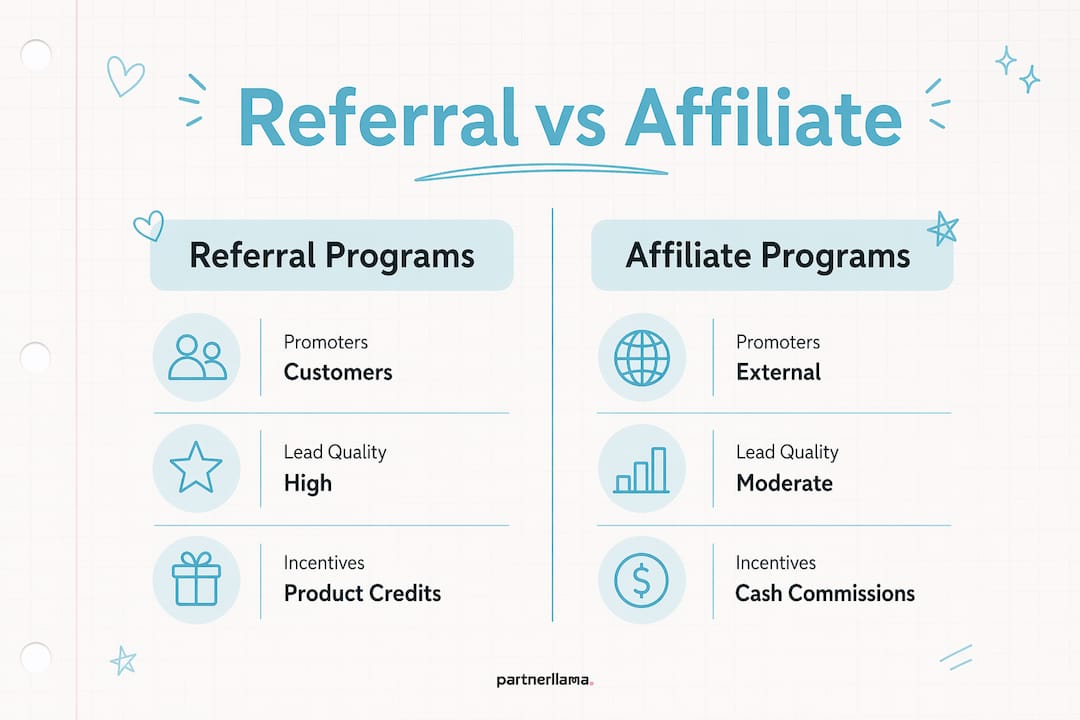
Affiliate leads are colder. They arrive through a blog post, a YouTube review, or a comparison page. Volume is higher, but conversion rates and lifetime value (LTV) are lower. That does not make affiliates less valuable. It means you need to account for the difference in your customer acquisition cost (CAC) to LTV ratio when setting commission rates.
Commission benchmarks reflect this quality gap. Referral programs typically offer 10–20% of first-year ARR or 5–15% MRR as a reward. Affiliate programs often pay flat fees of $100–$500 per conversion or 20–30% of first-year ARR for affiliates who drive significant volume. The higher affiliate payout compensates for the lower conversion rate and the cost of managing a professional partner relationship.
The ROI calculation also depends on retention. Referral customers tend to stay longer because they were sold by someone they trust, not by a paid promotion. That retention advantage compounds over time and makes referral programs exceptionally efficient for SaaS businesses with strong net revenue retention. You can read more about SaaS affiliate commission structures to benchmark your own program against industry norms.
When should SaaS businesses launch referral vs affiliate programs?
Sequencing matters more than most marketers realize. Launching a referral program first is recommended for most SaaS companies because it carries lower risk and operational overhead. You need a satisfied customer base before referrals work. Asking unhappy customers to refer friends produces nothing and damages trust.
The right time to launch a referral program is when your Net Promoter Score (NPS) is consistently positive and your onboarding is stable. Timing the referral ask matters as much as the reward itself. The most effective referral prompts occur right after a value-driven moment, such as completing onboarding or receiving a positive NPS response. Asking at the wrong moment, like during a support ticket, kills participation.
Affiliate programs make sense once you have outgrown your existing customer base as a growth channel. They are a paid distribution mechanism. You are essentially buying reach from creators and publishers who already have the audience you want. That requires budget, tracking infrastructure, and someone to manage partner relationships actively.
Here is a practical sequencing framework:
- Launch referral programs once you have at least 100 active paying customers and a stable onboarding flow.
- Introduce affiliate programs when organic and referral growth plateaus and you have budget for commission payouts and program management.
- Keep the programs operationally separate from day one. Mixing referral and affiliate programs without differentiation causes friction due to different economics, attribution, and management needs.
- Assign dedicated owners to each program. A single person managing both will inevitably prioritize one and neglect the other.
Pro Tip: Build your referral program into your onboarding email sequence. A well-timed referral ask at day 14 or day 30, when users have experienced real value, consistently outperforms a standalone referral page.
If you are building from scratch, the affiliate program setup guide from PartnerLlama walks through the infrastructure decisions you need to make before you recruit a single partner.
What are the common pitfalls in SaaS referral and affiliate programs?
The most expensive mistake in referral programs is paying on signups. Fraud is immediate and easy: one person creates multiple email accounts and collects rewards. Referral payouts should be triggered by meaningful product-use milestones, such as a first payment or reaching a usage threshold, with fraud checks on email, IP, and device data. This single change eliminates the majority of referral fraud.
Reward design is the second major failure point. Cash rewards in referral programs attract people who want the cash, not people who genuinely love your product. Product-native rewards like free months and credits generally outperform cash rewards because they align incentives and reduce fraud. A customer who earns a free month has a reason to stay engaged. A customer who earns $20 has no such reason.
For affiliate programs, the most common pitfall is poor partner communication. Affiliates are professionals. They will drop your program if payouts are delayed, tracking is unreliable, or commission terms change without notice. Build a clear partner agreement, automate your payout schedule, and give affiliates a real-time dashboard to monitor their performance.
Two-sided incentive structures in referral programs convert better because both the referrer and the new user benefit. Giving the new user a discount or extended trial alongside the referrer's reward increases participation rates. Running a one-sided referral program where only the referrer benefits leaves conversion on the table.
Pro Tip: Run a quarterly audit of your affiliate program. Remove inactive affiliates, renegotiate terms with top performers, and check for attribution anomalies. Programs that go unaudited for six months almost always have fraud or misattribution problems.
Key Takeaways
SaaS referral programs deliver higher-quality leads at lower cost, while affiliate programs deliver volume at higher operational complexity. Running both requires distinct incentive structures, tracking systems, and management resources.
| Point | Details |
|---|---|
| Referral vs affiliate promoters | Referral promoters are existing customers; affiliates are external marketers with different motivations. |
| Lead quality tradeoff | Referral close rates run 5–10x higher than affiliate leads, but affiliates generate more volume. |
| Commission benchmarks | Referrals pay 10–20% of first-year ARR; affiliates often earn 20–30% ARR or flat fees of $100–$500. |
| Program sequencing | Launch referral programs first, then add affiliate programs once organic growth plateaus. |
| Fraud prevention | Tie payouts to usage or payment milestones, not signups, and use product-native rewards for referrals. |
Why most SaaS teams get this wrong from the start
The mistake I see most often is treating referral and affiliate programs as the same thing with different names. Teams build one set of terms, one tracking setup, and one payout schedule, then wonder why neither program performs. The economics are fundamentally different. Referral programs are relationship-based. Affiliate programs are media-based. Conflating them is like running your PR budget and your paid search budget from the same spreadsheet.
The second mistake is launching affiliate programs too early. I have watched early-stage SaaS teams spend months recruiting affiliates before they have product-market fit or a stable onboarding flow. Affiliates send traffic. If your product does not convert or retain, you pay commissions and get nothing back. Referral programs force you to earn growth from satisfied customers first. That discipline is valuable.
What actually works is treating each program as its own revenue channel with its own KPIs, its own budget, and its own owner. Referral programs should be measured on CAC, LTV, and NPS correlation. Affiliate programs should be measured on cost per acquisition, conversion rate by partner, and 90-day retention. When you separate the metrics, you stop making decisions that optimize one program at the expense of the other.
The teams that scale both programs successfully share one trait: they invest in the infrastructure before they invest in recruitment. Tracking, fraud controls, payout automation, and partner communication all need to be in place before you bring in your first affiliate or send your first referral email. Recruiting partners into a broken system is the fastest way to burn your reputation in a market where word travels fast.
— Isabel
How PartnerLlama helps you build and manage both programs
Running a referral program and an affiliate program at the same time requires more than a single tracking link. It requires separate incentive logic, distinct partner segments, and lifecycle communication that converts partner-driven traffic into paying customers.

PartnerLlama manages the full partner lifecycle, from onboarding and activation through retention and performance reporting. The lifecycle email marketing service is built specifically to convert affiliate and partner traffic into long-term subscribers, not just first-time signups. For teams that need end-to-end program management, the affiliate marketing management service covers recruitment, tracking, payout automation, and partner communication in one place. If you are ready to build a program that performs, PartnerLlama gives you the infrastructure and the strategy to do it right.
FAQ
What is the core difference between referral and affiliate programs?
Referral programs reward existing customers for recommending your product to peers. Affiliate programs pay external marketers a commission for driving traffic and conversions from their own audiences.
Which program delivers better lead quality for SaaS?
Referral programs deliver significantly better lead quality. Referral close rates run 5–10x higher than affiliate leads because the recommendation comes from a trusted peer rather than a paid promotion.
What commission rates are standard for SaaS affiliate programs?
SaaS affiliate programs typically pay flat fees of $100–$500 per conversion or 20–30% of first-year ARR for high-volume partners. Referral programs usually offer 10–20% of first-year ARR or 5–15% MRR in product credits or cash.
When should a SaaS company launch an affiliate program?
Launch an affiliate program after your referral program is running and organic growth has plateaued. Affiliate programs require budget, tracking infrastructure, and active partner management, making them better suited to companies past early product-market fit.
How do you prevent fraud in SaaS referral programs?
Tie referral payouts to meaningful milestones like first payment or active usage rather than signups. Add fraud checks on email addresses, IP addresses, and device data to catch duplicate accounts before rewards are issued.