

An affiliate network is defined as a third-party intermediary platform that connects advertisers with affiliate publishers, providing centralized infrastructure for tracking, commission payments, and fraud screening. Understanding the role of affiliate network explained correctly is the difference between launching a program that scales and one that stalls. Platforms like ShareASale and Awin have built entire ecosystems on this model, giving brands instant access to thousands of vetted publishers. PartnerLlama works with brands at every stage of this process, from initial network selection through to migrating top affiliates into direct programs. The core value is speed and infrastructure, but the trade-offs in cost and control are real and worth understanding before you commit.
What does an affiliate network actually do?
An affiliate network functions as the operational backbone of performance marketing. It handles the tasks that would otherwise require a dedicated in-house tech stack: tracking referrals, attributing conversions, managing payouts, and screening for fraud. Networks like Awin, ShareASale, CJ Affiliate, and Impact Radius each operate as centralized marketplaces where advertisers list their programs and affiliates browse and apply to promote them.
Here is how the core process works in practice:
- Advertiser joins the network. A brand creates a program listing, sets commission rates, and uploads creative assets. The network hosts all of this in a standardized format that affiliates already know how to navigate.
- Affiliates discover and apply. Publishers search the network's marketplace for programs that match their audience. A personal finance blogger might apply to a fintech brand's program directly through CJ Affiliate without ever contacting the brand directly.
- Tracking fires on every referral. When a visitor clicks an affiliate link, the network's tracking technology records the click, session, and eventual conversion. This data feeds into the network's reporting dashboard.
- Commissions are calculated and paid. The network consolidates payouts on Net-30 or Net-60 schedules, meaning brands pay one invoice and the network distributes funds to each affiliate. This removes the accounting complexity of paying dozens of publishers individually.
- Fraud screening runs continuously. Networks apply automated rules to flag suspicious traffic patterns, duplicate transactions, and cookie stuffing. This is a baseline protection layer, though it is not foolproof.
The infrastructure function of networks covers tracking, reporting, payments, and fraud detection as a bundled service. That bundling is the core value proposition for brands that do not want to build this infrastructure themselves.
Pro Tip: Before joining any network, request a sample fraud report from a brand already running on that platform. The quality of that report tells you more about the network's real capabilities than any sales deck.

Affiliate networks vs. direct programs: key differences
The choice between using an affiliate network and running a direct affiliate program is one of the most consequential decisions in performance marketing. Both approaches work, but they serve different stages of a brand's growth.
| Factor | Affiliate Network | Direct Affiliate Program |
|---|---|---|
| Launch speed | Days to weeks | Weeks to months |
| Affiliate access | Immediate, large pool | Built over time |
| Cost | 20–30% commission markup | Lower long-term cost |
| Data ownership | Network retains data | Brand owns all data |
| Fraud control | Network-level screening | Brand-defined rules |
| Relationship depth | Shallow, platform-mediated | Direct, high-trust |
Direct affiliate programs give brands full control over affiliates, commission rules, and compliance standards. The trade-off is that building that program from scratch requires more time, technology, and management effort.
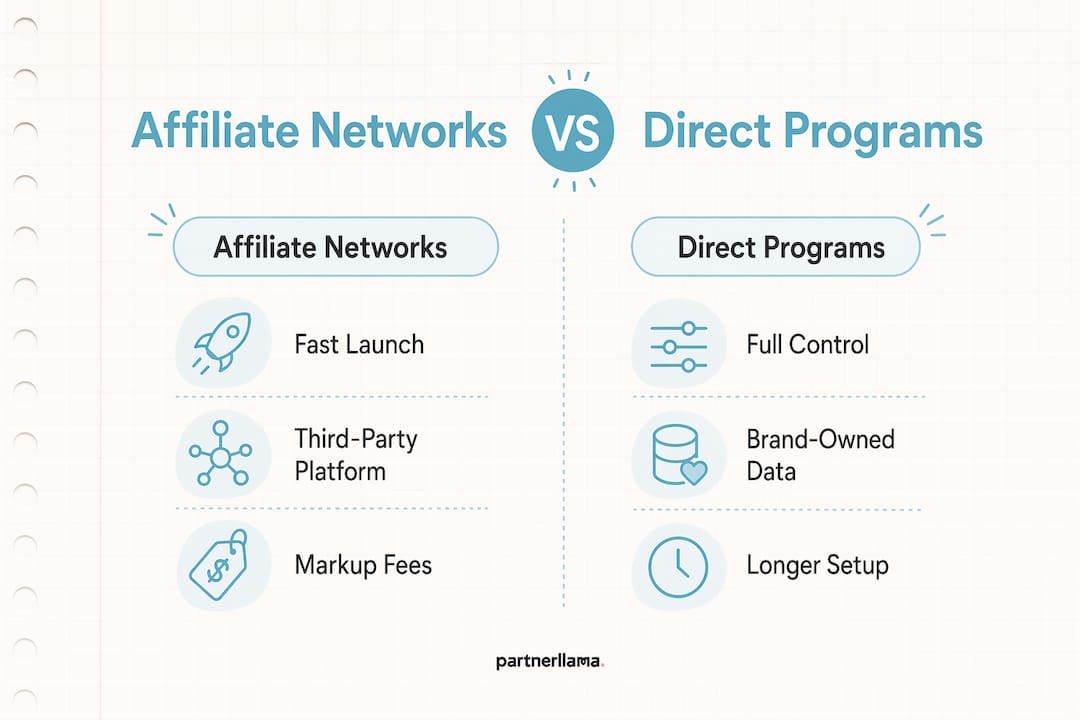
Networks, by contrast, provide instant legitimacy. Affiliate networks act as trusted third-party arbiters, giving smaller or newer brands a credibility signal that helps attract top-tier publishers who would otherwise ignore an unknown program. A DTC skincare brand with no affiliate history has a far better chance of recruiting a high-traffic beauty blogger through Awin than by cold-emailing that blogger directly.
The real cost of networks is not just the markup. Brands also lose ownership of affiliate data, which creates what experienced operators call a "platform trap." You build a roster of productive affiliates, but the relationship lives inside the network. If you leave, you lose the contact history, performance data, and often the relationship itself.
Pro Tip: From day one on any network, build a separate CRM record for every affiliate who drives meaningful volume. Capture their contact details, niche, and performance benchmarks outside the network. This data is yours regardless of what platform you use.
How affiliate networks accelerate brand expansion
Speed is the most underrated advantage of affiliate networks. Brands can launch and scale in new geographies within days or weeks, compared to the months required to build a direct affiliate program from the ground up. For a brand entering a new market, that time difference is significant.
Networks provide this speed through several structural advantages:
- Pre-vetted affiliate rosters. Networks like Awin maintain active publishers across dozens of verticals and regions. A brand targeting the UK market can find and activate British affiliates within the same week it joins the network.
- Standardized contracts and compliance. Network terms of service cover the legal relationship between advertiser and affiliate. Brands do not need to draft individual agreements for each publisher.
- Centralized payment infrastructure. One payment to the network covers all affiliate payouts across currencies and countries. This matters enormously for brands scaling into markets with different payment rails.
- Instant affiliate discovery. Networks give brands immediate access to a large affiliate pool, solving the cold-start problem that kills many direct programs in their early months.
For brands running affiliate program expansion into new segments or geographies, networks function as a volume accelerator. The goal is not to stay on the network forever. The goal is to use it to identify which affiliates, niches, and regions actually convert, then build on that intelligence.
What are the financial costs of using affiliate networks?
The financial structure of affiliate networks is straightforward but often underestimated in its cumulative impact. Networks typically charge advertisers a 20–30% commission markup on top of every commission paid to affiliates. This markup covers the network's tracking, payment processing, and support services.
Here is how the math plays out in practice:
- Calculate your true cost per acquisition. If your affiliate commission is $20 and the network markup is 25%, your actual cost per conversion is $25. Over thousands of conversions, that gap compounds quickly.
- Account for payout timing. Net-30 and Net-60 payout schedules create a predictable cash flow cycle, which is useful for accounting. But brands must hold funds in reserve to cover upcoming payouts, which ties up working capital.
- Factor in fraud exposure. Attribution disputes in networks tend to be resolved in favor of affiliates, which increases fraud costs borne by merchants. A brand with weak fraud controls on a large network can absorb significant losses before the problem becomes visible in reporting.
- Assess the opportunity cost of lost data. Brands lose ownership of affiliate data on networks. The cost of rebuilding that data in a direct program later is real, even if it does not appear on a P&L.
Networks reduce the operational burden by outsourcing tracking, payout, and compliance management to the platform. That convenience has genuine value, especially for lean marketing teams. The question is whether the markup is worth it at your current volume and margin structure.
Pro Tip: Run a quarterly cost-per-acquisition audit that separates network fees from affiliate commissions. Most brands discover the true network cost is 15–20% higher than they assumed when they first joined.
How to integrate affiliate networks into your marketing strategy
The most effective approach to affiliate networks treats them as a phase in a longer program lifecycle, not a permanent solution. Brands often use affiliate networks as a launchpad for 6–12 months before migrating high-value affiliates to direct programs to recapture margins and gain control. This phased model is the standard playbook for brands that eventually build mature affiliate programs.
Here is how to execute that strategy well:
- Use the network to identify your best affiliates. Run your program on a network for at least one full quarter before drawing conclusions. Look for affiliates who drive consistent volume, low return rates, and high average order values.
- Build direct relationships in parallel. Contact your top performers personally. Offer them better commission rates, exclusive promotions, or early product access in exchange for moving to a direct relationship. Most high-quality affiliates prefer direct programs because they get better terms and faster communication.
- Maintain the network for volume and discovery. Even after migrating your top affiliates, keep the network active for new affiliate recruitment and geographic expansion. Networks are excellent for finding new partners. They are less effective for managing mature, high-value relationships.
- Prioritize data ownership from the start. Track every affiliate's performance in your own analytics system, not just the network dashboard. This data belongs to you and should inform every strategic decision you make about the program.
- Set compliance standards the network cannot enforce. Networks apply baseline rules, but brand-specific compliance, such as content guidelines, discount restrictions, and attribution windows, requires direct oversight. Build those rules into your direct agreements.
The affiliate marketing basics of this approach come down to one principle: use networks for what they do best, which is scale and speed, and build direct infrastructure for what they cannot provide, which is control and data ownership.
Key takeaways
Affiliate networks are the fastest path to affiliate volume, but the brands that win long-term treat them as a launchpad, not a permanent home.
| Point | Details |
|---|---|
| Networks are infrastructure | They handle tracking, payments, and fraud screening so brands can launch without building tech from scratch. |
| Cost markup is real | Networks add 20–30% on top of affiliate commissions, which compounds significantly at scale. |
| Data ownership is the hidden risk | Brands lose affiliate data when they rely solely on networks, creating a platform dependency that is costly to reverse. |
| Use networks as a launchpad | A 6–12 month network phase helps identify top affiliates before migrating them to direct programs for better margins. |
| Direct programs require more effort | Full control over affiliates and data comes at the cost of more setup, management, and technology investment. |
Where most brands get affiliate networks wrong
I have worked with brands across DTC, SaaS, and health and wellness, and the pattern is almost always the same. A marketing team joins ShareASale or Awin, activates a few hundred affiliates, and then treats the network dashboard as their program. They check the revenue number, pay the invoice, and move on. Six months later, they wonder why their cost per acquisition keeps climbing.
The mistake is treating the network as the program rather than as the infrastructure for a program. Networks are excellent at connecting you with affiliates. They are not designed to build the kind of relationship depth that drives long-term affiliate loyalty and performance. That work has to come from you.
The brands I have seen build genuinely strong affiliate programs all share one habit: they treat their top ten affiliates like business partners, not line items. They know those affiliates by name, understand their audiences, and communicate with them directly. That relationship does not live inside a network dashboard. It lives in your inbox and your CRM.
The other thing I would push back on is the assumption that moving off a network is always the right goal. For brands with limited internal resources, the operational convenience of a network is genuinely worth the markup. The question is not whether to use a network. The question is whether you are using it strategically or just defaulting to it because it is easy.
My recommendation is a phased approach. Use the network to launch and learn. Identify your top performers. Build direct relationships with those affiliates. Then decide, based on your actual margin data, whether the network fee is still worth paying for the remaining volume.
— Isabel
Build a partner program that grows beyond the network
If you are running an affiliate program through a network and wondering why growth has plateaued, the answer is usually not the network itself. It is the absence of a lifecycle strategy around it. PartnerLlama builds complete affiliate and partner programs that cover every stage from onboarding and activation through retention and performance optimization.

PartnerLlama's affiliate marketing management service is built for DTC and SaaS brands that want to turn a network-dependent program into a scalable, owned revenue channel. From commission and payout management to lifecycle marketing for partner traffic, every service is designed to give you more control, better data, and stronger affiliate relationships. If your program is ready to move beyond the basics, PartnerLlama is built for exactly that stage.
FAQ
What is an affiliate network in simple terms?
An affiliate network is a platform that connects brands with affiliate publishers, handling tracking, payments, and fraud screening in one centralized system. ShareASale, Awin, and CJ Affiliate are widely used examples.
How do affiliate networks make money?
Networks charge advertisers a markup of 20–30% on top of affiliate commissions, plus setup fees in some cases. This fee covers the network's tracking technology, payment processing, and support services.
What is the difference between an affiliate network and an affiliate program?
An affiliate program is a brand's own set of rules, commissions, and affiliate relationships. An affiliate network is the third-party platform that hosts and manages those relationships on the brand's behalf.
When should a brand move affiliates off a network?
Most brands begin migrating top-performing affiliates to direct programs after 6–12 months on a network. The trigger is usually a combination of sufficient volume, identified top performers, and a desire to recapture the 20–30% network markup.
Do affiliate networks prevent fraud?
Networks apply baseline fraud screening, but attribution disputes tend to favor affiliates, which means brands still carry meaningful fraud risk. Direct programs with brand-defined rules offer stronger fraud controls.