

An affiliate commission is the payout a partner earns when they drive a specific action, such as a sale or lead, through their unique tracking link. Understanding how affiliate commissions work explained in full means knowing not just the rates, but the structures, tracking mechanics, and payout timelines that determine when and how much you actually get paid. Programs like Amazon Associates, ShareASale, and SaaS platforms each handle commissions differently, and those differences have a direct impact on your earnings. This guide breaks down every layer of the affiliate commission system so you can make smarter decisions from day one.
How do affiliate commissions work?
An affiliate commission is calculated as either a percentage of a sale or a flat fee, triggered when a customer completes a desired action after clicking your unique affiliate link. That link contains a tracking ID that connects the sale back to you. When a visitor clicks your link, a cookie is stored in their browser to maintain that connection through the purchase process.
Typical commission rates range from 5% to 30% for physical products and 20% to 50% for digital products and SaaS. SaaS programs often pay 20–30% monthly on recurring subscriptions, which compounds over time. A $100 SaaS subscription at 25% recurring commission pays you $25 every month that customer stays subscribed.

Amazon Associates is one of the most widely used entry points for affiliate marketing basics. Amazon's commission rates vary from 1% to 20% depending on product category. That range matters because a 1% commission on a $20 book earns you $0.20, while a 10% commission on a $500 electronics item earns $50 from a single sale.
What are the common affiliate commission structures?
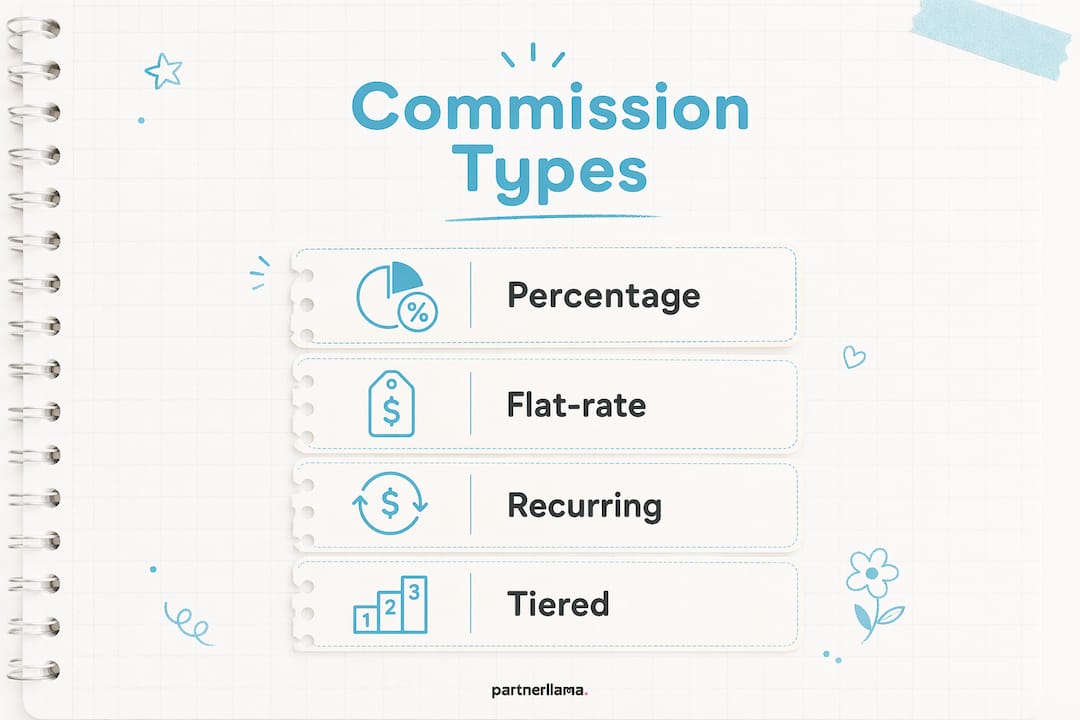
The four main affiliate commission structures are percentage-based, flat-rate, recurring, and tiered. Each fits a different business model and audience type.
Percentage commissions pay a fixed share of the sale value. Retail programs typically sit in the 5%–15% range. Digital product programs often go higher, sometimes reaching 50% because the seller's cost to deliver the product is near zero.
Flat-rate commissions pay a set dollar amount per action regardless of order value. A software company might pay $50 for every free trial signup, no matter what plan the user eventually buys. This model works well for lead generation programs.
Recurring commissions are the most valuable structure for long-term income. Subscription-based models pay you every billing cycle as long as the referred customer stays active. One successful referral can generate months or years of passive income.
Tiered commissions reward volume. A program might pay 10% for your first 10 sales per month, then 15% for sales 11–25, and 20% beyond that. This structure motivates top performers to push harder.
| Structure | Best for | Pros | Cons |
|---|---|---|---|
| Percentage-based | Retail, ecommerce | Scales with order value | Low rates on cheap products |
| Flat-rate | Lead gen, SaaS trials | Predictable per-action income | No upside on high-value sales |
| Recurring | SaaS, subscriptions | Compounds over time | Requires customer retention |
| Tiered | High-volume affiliates | Rewards performance | Slow to benefit at low volume |
How does affiliate tracking work to assign commissions accurately?
Affiliate tracking is the system that connects a customer's purchase back to the specific partner who referred them. Every affiliate gets a unique link containing a tracking ID. When a visitor clicks that link, the program drops a cookie in their browser that records the affiliate's ID and a timestamp.
Cookie durations vary widely across programs. Amazon uses a 24-hour cookie window, meaning the customer must complete their purchase within one day of clicking your link. Other programs use 30, 60, or 90-day windows. A longer cookie window gives you more time to earn credit, especially for high-consideration purchases.
Affiliate tracking technology also determines how attribution is assigned when multiple affiliates touch the same customer. Most programs use last-click attribution by default. The last affiliate whose link the customer clicked before buying gets 100% of the commission.
The commission payout lifecycle moves through five stages:
- Pending: The sale is tracked but not yet verified.
- Approved: The merchant confirms the sale is valid.
- Rejected/Reversed: The sale fails a check, often due to fraud or a return.
- Locked: The commission is queued for the next payment cycle.
- Paid: Funds are settled to your account.
Payout timelines typically include a 30 to 60-day hold period to cover potential refunds. Most programs also require a minimum balance before releasing payment. Monthly payout cycles with a $50 or $100 minimum threshold are standard across major networks.
Pro Tip: Always check a program's cookie duration and hold period before joining. A 24-hour cookie on a product that takes a week to research is a structural disadvantage you cannot overcome with better content.
What are the best practices for optimizing affiliate commission earnings?
The most reliable path to higher affiliate income is audience trust alignment, not raw traffic volume. An affiliate with 5,000 highly engaged readers in a specific niche will consistently outperform one with 100,000 casual visitors who have no connection to the products being promoted. Trust converts. Traffic alone does not.
Earnings Per Click (EPC) is the metric that separates experienced affiliates from beginners. EPC measures how much you earn on average for every click your affiliate links receive. A program paying 5% commission with a 15% conversion rate will often outperform a program paying 40% with a 0.5% conversion rate. Always calculate EPC before committing to a program.
- Calculate EPC before joining any program. Divide your total earnings by total clicks to get a real performance number.
- Prioritize programs with longer cookie windows. A 90-day window gives you far more earning opportunities than a 24-hour window.
- Read the affiliate agreement in full. Commission caps, restricted promotional methods, and payout minimums all affect your actual income.
- Disclose your affiliate relationships clearly. The FTC requires a visible statement like "I may earn a commission for purchases made through these links." Vague labels like "spon" or buried footer disclosures do not meet compliance standards.
- Focus on one niche before expanding. Niche focus improves conversion rates because your audience came to you for that specific topic.
Pro Tip: Recurring commission programs in SaaS are worth promoting even at lower initial rates. A customer retained for 12 months at 25% monthly commission generates far more total income than a one-time 50% payout on a $30 product.
What challenges and nuances do beginners frequently miss?
The biggest misconception in affiliate marketing is treating a tracked sale as confirmed revenue. A pending commission is not money in your account. It can sit in pending status for 30 to 60 days, and it can be reversed at any point during that window if the customer returns the product.
Returns and refunds directly reduce your commissions. If a merchant has a 30-day return policy and you are in a 30-day hold period, a returned item wipes out that commission entirely. High-return product categories like fashion and electronics carry more risk for affiliates than digital downloads or SaaS subscriptions.
Cookie overwriting is a problem most beginners never anticipate. Last-click attribution is the default for roughly 90% of programs. If a customer clicks your link on monday, then clicks a competitor affiliate's link on friday before buying, you receive nothing. Your earlier referral work earns zero credit.
Reading the affiliate agreement before you start promoting is not optional. Commission caps, prohibited traffic sources, and clawback clauses are buried in those documents. Ignoring them is the fastest way to lose earnings you thought you had already secured.
A few other nuances worth knowing:
- Some programs cap commissions per order, regardless of order size.
- Sub-affiliate networks add a layer between you and the merchant, which can slow payouts further.
- Programs can change commission rates with little notice, so diversifying across multiple programs protects your income.
- Audience trust is the one asset no program change can take from you. Build it deliberately.
Key Takeaways
Affiliate commissions pay partners for verified actions, tracked through unique links, validated through a multi-stage lifecycle, and paid out after hold periods that can extend 30 to 60 days.
| Point | Details |
|---|---|
| Commission structures vary | Percentage, flat-rate, recurring, and tiered models each suit different products and goals. |
| Tracking relies on cookies | Cookie durations range from 24 hours (Amazon) to 90 days, directly affecting your earning window. |
| EPC beats raw commission rates | A lower rate with high conversion earns more than a high rate with poor conversion. |
| Pending does not mean paid | Commissions sit in hold for 30–60 days and can be reversed by refunds before payout. |
| FTC disclosure is mandatory | Clear affiliate disclosure protects your legal standing and builds audience trust. |
What I have learned after years of watching affiliate programs succeed and fail
Most affiliates spend their energy chasing the highest commission percentage. That is the wrong metric to chase. I have seen partners walk away from 40% commission programs because the product had a 35% return rate and a 60-day hold period. On paper, the rate looked great. In practice, the cash flow was a mess and the reversals were constant.
The programs that consistently produce real income share two traits: they have products people genuinely want to buy, and they treat their affiliates as partners rather than traffic sources. Transparent reporting, fair attribution windows, and predictable payout cycles matter more than a flashy commission percentage.
The other lesson I keep coming back to is this: read the agreement before you build a single piece of content around a program. Commission structures change. Programs get acquired. Payout thresholds shift. The affiliates who build sustainable income are the ones who treat their program selection with the same rigor they apply to their content strategy. They diversify, they track EPC, and they never confuse a pending commission with money they can spend.
— Isabel
How PartnerLlama helps you build a commission program that actually pays
Running an affiliate program means more than setting a commission rate and hoping partners promote. PartnerLlama manages the full partner lifecycle, from onboarding and activation through performance tracking and payout management.

For brands that want to turn affiliate traffic into retained customers, PartnerLlama's lifecycle email marketing keeps referred customers engaged long after the first purchase. For those building or rebuilding a program from scratch, the affiliate marketing management service covers commission structure design, tracking setup, and partner performance reporting. Every program is built around your specific product, audience, and growth goals.
FAQ
What is an affiliate commission?
An affiliate commission is a payment made to a partner when they drive a specific action, such as a sale or lead, through their unique tracking link. Commission rates typically range from 5% to 50% depending on the product type and program structure.
How long does it take to receive affiliate commission payments?
Most programs hold commissions for 30 to 60 days to cover refund windows before releasing payment. Monthly payout cycles with minimum balance thresholds are standard across major affiliate networks.
What is the difference between recurring and one-time commissions?
A one-time commission pays a single amount per sale, while a recurring commission pays every billing cycle the referred customer remains active. Recurring commissions are most common in SaaS and subscription programs.
Why did my affiliate commission get reversed?
Commissions are reversed when a customer returns a product, when fraud is detected, or when the sale violates program terms. This is why commissions sit in pending status before being approved and locked for payment.
What is EPC in affiliate marketing?
EPC stands for Earnings Per Click and measures your average earnings for every click your affiliate links receive. It is a more reliable performance indicator than commission rate alone because it accounts for both conversion rate and commission value.