

Affiliate program setup is the process of building a performance-based referral system where partners earn commissions for driving sales or leads through tracked links. The industry term for this is affiliate marketing, and the setup phase is where most programs either succeed or quietly fail. Done right, it creates a revenue channel that pays only for results. Done wrong, it becomes a compliance headache with affiliates who never convert. Platforms like Shopify, Rakuten, and Impact are common starting points, but the structure you build around them matters far more than the platform itself.
What is affiliate program setup, and how does it work?
Affiliate program setup is the act of creating a tracked commission system that connects your brand, your affiliates, and your customers in one measurable loop. Affiliate links attribute sales to specific partners using cookie durations of 30, 60, or 90 days. Each sale within that window earns the affiliate a commission, and your tracking software records the attribution.
The three players in every program are the business (you), the affiliate (the partner promoting your product), and the customer (the buyer). Affiliates can be bloggers, content creators, email marketers, or comparison sites. The business sets the rules, the commission rate, and the tools. The affiliate drives traffic. The customer converts.

Understanding affiliate marketing basics before you build helps you avoid the most common structural mistakes. Most brands underestimate how much the program design shapes affiliate behavior before a single partner is recruited.
What are the key steps to set up an affiliate program?
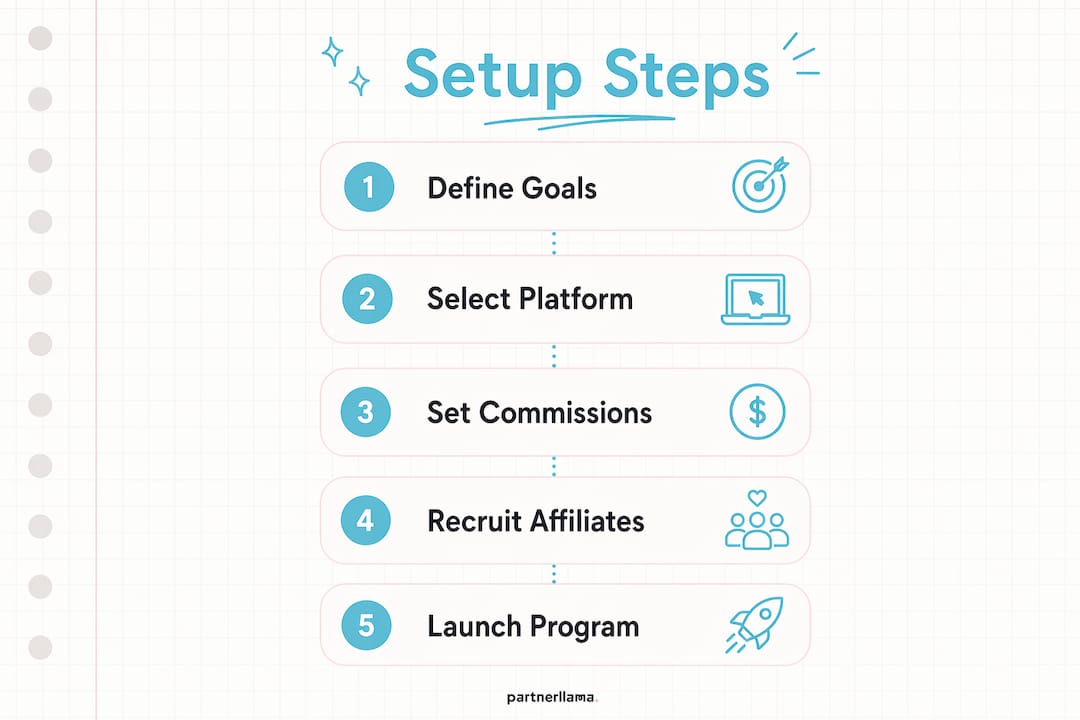
Launching an affiliate program typically involves 9 to 11 steps, depending on your business model and the platform you choose. Skipping steps early creates problems at scale. Here is the sequence that works:
- Set clear goals. Define what success looks like before anything else. Are you after new customer acquisition, market expansion, or increased average order value? Your goal shapes every decision that follows.
- Choose your tracking platform. Select affiliate software or a network that fits your tech stack. Options range from in-house tools built on Shopify to managed networks like Rakuten Advertising or Impact.
- Define your commission structure. Decide on your model (CPA, CPL, tiered, or hybrid) and set rates that make sense for your margins. A physical goods brand and a SaaS company have very different economics here.
- Set cookie durations. Match your cookie window to your sales cycle. Thirty days works for impulse purchases. Sixty or ninety days fits high-ticket items or SaaS trials.
- Write your affiliate terms. Cover approved promotion methods, FTC disclosure requirements, brand usage rules, and commission reversal conditions. These terms protect you and set clear expectations for partners.
- Create affiliate assets. Build a library of banners, product images, email copy, and tracking links. Affiliates who have ready-made creatives activate faster and perform better.
- Recruit and vet affiliates. Identify partners whose audience matches your customer profile. Quality beats volume every time.
- Onboard your affiliates. Walk new partners through your program, your brand guidelines, and your tools. A structured onboarding cuts the time to first sale significantly.
- Track, measure, and optimize. Monitor performance by affiliate, by channel, and by creative. Cut what does not convert. Reward what does.
Pro Tip: Test your tracking and attribution setup with internal orders before you recruit a single affiliate. Validate tracking first to confirm that every sale is recorded correctly. Fixing attribution errors after affiliates are live is far more disruptive than catching them early.
How do commission structures and cookie durations affect program success?
Commission models should align with your business goals and the behavior you want to reward. The four most common models each serve a different purpose.
| Model | Best For | How It Pays |
|---|---|---|
| CPA (cost per acquisition) | Brands focused on new customers | Fixed amount per completed sale |
| CPL (cost per lead) | SaaS or service brands building pipelines | Fixed amount per qualified lead |
| Tiered commission | Programs rewarding high-volume affiliates | Rate increases as affiliate hits thresholds |
| Hybrid | Brands wanting both volume and quality | Base CPA plus a bonus for hitting targets |
Cookie duration is the window of time after a click during which a sale is credited to the affiliate. Thirty days is the standard default, sixty days fits email marketing campaigns where buyers take longer to decide, and ninety days suits high-ticket products or SaaS with longer evaluation cycles. Choosing the wrong window means affiliates lose credit for sales they genuinely influenced.
Payment timing also matters. Affiliate commissions are typically paid on net-30 or net-60 schedules after a sale clears. That delay exists to cover refunds, chargebacks, and fraud. Affiliates who understand this upfront are less likely to dispute reversals later.
Pro Tip: For a deeper breakdown of how to build commission tiers that actually motivate partners, the affiliate commission structure guide from PartnerLlama covers the math behind rates that work for both DTC and SaaS models.
What compliance and terms should you set before launching?
Affiliate terms must be written before launch, covering approved promotion methods, commission structures, payment policies, and compliance rules. Skipping this step is the fastest way to damage your brand through an affiliate you barely know.
Your terms should address:
- Approved promotion channels. Specify where affiliates can and cannot promote. Paid search, social media, email, and coupon sites each carry different risks.
- Prohibited actions. Ban trademark bidding on your brand name in paid search, spam, misleading claims, and fake reviews. State the consequences clearly.
- FTC disclosure requirements. FTC endorsement guidelines require affiliates to disclose material connections clearly and in context. A phrase like "I may earn a commission for purchases made through these links" placed near the link is the standard. Vague disclosures buried in footers do not meet the standard.
- Commission reversal rules. Define exactly when commissions are reversed. Refunds, chargebacks, and fraudulent orders are the most common triggers.
- Payment thresholds and schedules. Set a minimum payout amount and confirm your net-30 or net-60 schedule in writing.
Defining eligibility, restrictions, and reversal rules before launch is what separates programs that scale cleanly from those that generate disputes. Clear terms also make it easier to remove bad actors without legal ambiguity.
How do you recruit, onboard, and manage affiliates effectively?
Strong affiliate programs treat partners as real business relationships, not traffic sources. Effective programs enable partners with creative assets, training, and ongoing support rather than just handing over a link and hoping for the best.
Recruitment works best when you start narrow. Identify affiliates whose existing audience matches your customer profile. A fitness supplement brand recruiting general lifestyle bloggers will see lower conversion rates than one recruiting certified personal trainers or sports nutrition reviewers. Niche fit matters more than follower count.
Vetting affiliates before approval protects your brand. Review their content quality, audience engagement, and promotion methods. An affiliate with a small but highly engaged email list often outperforms one with a large but passive social following.
Onboarding sets the tone for the entire relationship. A structured onboarding process should include:
- A welcome email with program highlights and key contacts
- Access to a branded creative library (banners, product images, copy templates)
- A clear explanation of commission structure, cookie duration, and payment schedule
- Links to your affiliate terms and FTC disclosure guidelines
- A point of contact for questions
Ongoing management is where most programs fall short. Continuous tracking, performance optimization, fraud detection, and incentivization are required to keep a program healthy over time. Review affiliate performance monthly. Identify your top 20% and offer them higher commission tiers or exclusive promotions. Reach out to inactive affiliates with fresh creatives or a limited-time bonus. Remove affiliates who generate clicks but no conversions, especially if the traffic pattern looks suspicious.
Clear communication of terms prevents misunderstandings and protects your brand reputation. A monthly newsletter to your affiliate base with program updates, top performer shoutouts, and new creative assets keeps partners engaged without requiring heavy one-on-one time.
Key Takeaways
A successful affiliate program setup requires clean tracking, clear terms, and a commission structure aligned with your business goals before you recruit a single partner.
| Point | Details |
|---|---|
| Define goals first | Set measurable targets before choosing a platform or commission model. |
| Validate tracking early | Confirm attribution works correctly with test orders before recruiting affiliates. |
| Match cookie duration to sales cycle | Use 30 days for impulse buys, 60–90 days for high-ticket or SaaS products. |
| Write terms before launch | Cover FTC disclosures, prohibited actions, and reversal rules in writing upfront. |
| Treat affiliates as partners | Provide creatives, training, and regular communication to drive long-term performance. |
Where most affiliate programs actually break down
The most common mistake I see brands make is recruiting affiliates before their tracking is solid. They spend weeks building a partner roster, then discover that half their orders are not being attributed correctly. By that point, affiliates are frustrated, commissions are disputed, and the program has a credibility problem before it has generated meaningful revenue.
The second mistake is treating the affiliate agreement as a formality. Brands copy a generic terms template, publish it, and assume affiliates will read it. They do not. The brands that avoid disputes are the ones who walk new affiliates through the key rules during onboarding, not just point them to a PDF.
My honest advice: start with five to ten pilot affiliates before you open recruitment broadly. Use that pilot period to stress-test your tracking, your payout workflow, and your communication process. The steps to start an affiliate program look straightforward on paper, but the operational gaps only show up when real partners are generating real traffic.
The brands that build durable affiliate programs also think about the relationship differently. An affiliate who feels supported, paid on time, and given good creative assets will promote your product consistently. One who feels ignored will move on to a competitor's program. The difference between a program that grows year over year and one that stagnates is almost always the quality of the relationship, not the commission rate.
— Isabel
How PartnerLlama helps brands build affiliate programs that perform
Building an affiliate program from scratch takes more than picking a platform and setting a commission rate. It requires clean tracking infrastructure, compliant terms, recruited partners who actually convert, and a management process that keeps the program growing.

PartnerLlama manages the full affiliate program lifecycle for DTC brands, SaaS companies, and brands in beauty, health, and wellness. That means handling recruitment, onboarding, compliance, and performance optimization, not just sending you a list of potential partners. If your current program is underperforming or you are building one for the first time, PartnerLlama's affiliate marketing management gives you a team that has done this across dozens of programs. You get a system built for your business model, not a generic playbook.
FAQ
What is affiliate program setup?
Affiliate program setup is the process of creating a performance-based system where partners earn commissions for driving sales through tracked links. It includes defining commission structures, cookie durations, affiliate terms, and tracking infrastructure.
How many steps does it take to set up an affiliate program?
Launching an affiliate program typically involves 9 to 11 steps, including goal setting, platform selection, commission structure, compliance terms, affiliate recruitment, onboarding, and ongoing performance management.
What cookie duration should I use for my affiliate program?
A 30-day cookie is standard for most products. Use 60 days for email marketing campaigns and 90 days for high-ticket items or SaaS products with longer evaluation cycles.
What are the FTC requirements for affiliate programs?
The FTC requires affiliates to disclose material connections clearly and in context near the promotion. A statement like "I may earn a commission for purchases made through these links" placed close to the affiliate link meets the standard.
When should affiliates be paid their commissions?
Affiliate commissions are typically paid on net-30 or net-60 schedules after a sale clears. The delay covers refunds, chargebacks, and fraud prevention before commissions are approved and paid out.