

Affiliate program legal requirements are mandatory rules that govern transparency, fairness, and regulatory compliance in affiliate marketing relationships. Every business running an affiliate program must meet obligations set by the Federal Trade Commission (FTC), regional data protection authorities, and state-level regulators like those enforcing the California Consumer Privacy Act (CCPA). Failing to comply carries real consequences: penalties per violation can exceed $50,000 under FTC rules alone. The legal framework covers disclosures, written agreements, data privacy, and ongoing enforcement. Getting these right protects your brand, your revenue, and your affiliates.
What disclosures are legally required in affiliate programs?
Disclosure is the foundation of affiliate program compliance. The FTC's 2026 revised endorsement framework requires affiliates to disclose any material connection to a brand before the first affiliate link appears. A "material connection" includes any financial relationship, free product, or other benefit that could influence a recommendation. Consumers have a right to know when a recommendation is paid.
The standard for disclosure is "clear and conspicuous." That means the disclosure must be visible, readable, and placed where a consumer will actually see it before clicking. Burying a disclaimer in a footer or using vague language like "this post may contain links" does not meet the standard. The FTC expects plain language such as "I earn a commission if you buy through this link."

The 2026 framework also introduced dual disclosure rules for AI-assisted content. If an affiliate uses AI to generate or assist with promotional content, the post must disclose both the affiliate relationship and the AI involvement. For video and audio content, verbal disclosures must appear within the first 30 seconds. This rule closes a loophole that previously allowed AI-generated reviews to bypass standard disclosure norms.
Compliant disclosure practices include:
- Placing a clear statement at the top of any blog post, video description, or social media caption that contains affiliate links
- Using direct language: "This post contains affiliate links. I receive a commission at no extra cost to you."
- Adding a verbal statement at the start of any video or podcast episode featuring affiliate promotions
- Including a separate AI disclosure when content is generated or substantially assisted by AI tools
Pro Tip: Review your affiliate link management practices against the 2026 FTC standards. PartnerLlama's guide on affiliate link compliance covers placement rules and disclosure language that hold up to regulatory scrutiny.
How to build affiliate agreements that meet legal standards
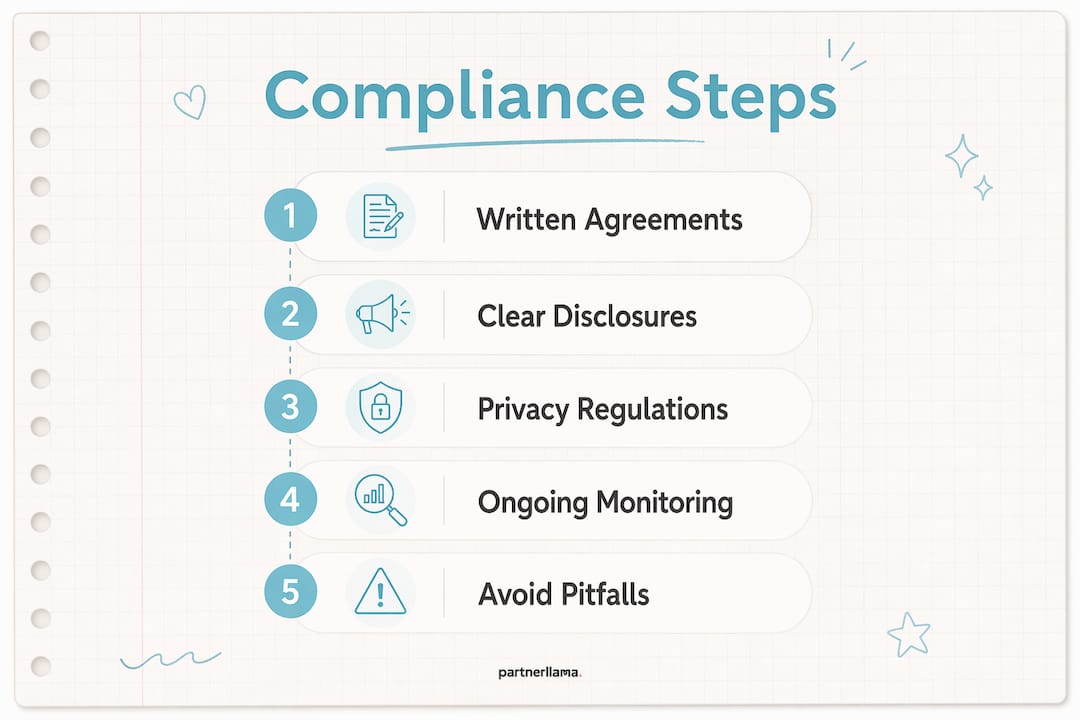
Every affiliate relationship must be backed by a formal written agreement. Verbal agreements, direct messages, or informal email threads do not satisfy regulatory expectations. A written contract creates an enforceable record of what both parties agreed to, which matters when regulators or courts get involved.
A legally sound affiliate agreement covers these core components:
- Disclosure compliance obligations. The agreement must require affiliates to follow FTC guidelines and any applicable regional laws. State explicitly that non-compliant content is grounds for termination.
- Brand safety rules. Define what promotional channels are permitted, what claims affiliates may make, and which content formats require pre-approval.
- Data protection requirements. Affiliates who collect or process consumer data on your behalf must agree to handle it according to GDPR, CCPA, and any other applicable privacy laws.
- Indemnification clauses. These protect you if an affiliate violates disclosure rules or makes deceptive claims. Without indemnification language, your brand may share liability for an affiliate's misconduct.
- Termination and commission clawback terms. Specify the conditions under which you can terminate the relationship and reverse commissions already paid for non-compliant activity.
The FTC holds program operators liable for affiliates' deceptive marketing when operators lack proactive controls. A generic "follow all applicable laws" clause is not enough. Regulators expect you to define the rules, train affiliates on them, and enforce them consistently.
Pro Tip: PartnerLlama's breakdown of the affiliate partner agreement covers every clause you need, including indemnification language and data protection terms that align with 2026 standards.
What multi-region privacy compliance rules impact affiliate programs in 2026?
Affiliate programs that operate across borders face a layered web of privacy regulations. Each regime has its own consent requirements, data transfer rules, and enforcement teeth. The table below outlines the major frameworks affecting affiliate data handling in 2026.
| Regulation | Region | Key affiliate obligation |
|---|---|---|
| EU GDPR | European Union | Lawful basis for tracking; Data Processing Addendums required |
| UK GDPR | United Kingdom | Post-Brexit mirror of EU GDPR with separate ICO enforcement |
| Brazil LGPD | Brazil | Consent-based data collection; DPA agreements mandatory |
| CCPA/CPRA | California, USA | Opt-out rights for data sale; consumer request handling |
| CAN-SPAM Act | United States | Affiliate email promotions must include opt-out mechanisms |
| PIPEDA | Canada | Consent required for personal data collection in affiliate flows |
| PDPA | Thailand | Explicit consent for cross-border data transfers |
| POPIA | South Africa | Lawful processing and data minimization for affiliate tracking |
Year-to-date 2026 GDPR enforcement has produced €1.2 billion in fines, while CCPA penalties have reached $50 million. These numbers show that regulators are actively pursuing violations, not just issuing warnings.
On the technical side, outdated cookie-based tracking no longer meets GDPR or CCPA standards. Server-side postback tracking, combined with compliant consent mechanisms like Consent Mode v2 and the IAB's Transparency and Consent Framework (TCF) v2.2, provides a legally defensible alternative. Affiliate agreements must also include Data Processing Addendums (DPAs) to satisfy GDPR Article 28, which governs the relationship between data controllers and processors.
What systems and processes ensure ongoing affiliate program compliance?
Compliance is not a one-time setup. It requires a living program with recorded policies, systematic monitoring, and documented enforcement actions. The table below compares a minimal compliance setup against a full compliance program.
| Capability | Minimal setup | Full compliance program |
|---|---|---|
| Affiliate vetting | Manual application review | Automated identity verification and traffic source checks |
| Disclosure monitoring | Periodic spot checks | Automated detection of missing or non-compliant disclosures |
| Data privacy controls | Basic cookie consent banner | Server-side tracking plus TCF v2.2 and DPAs in all agreements |
| Enforcement documentation | Informal notes | Logged warnings, commission clawbacks, and termination records |
| Audit readiness | No formal records | Centralized compliance dashboard with exportable reports |
Affiliate qualification processes that verify identity and traffic sources before granting program access reduce compliance risks significantly. Automated approval workflows can flag high-risk applicants based on traffic patterns, content history, or geographic location.
Ongoing monitoring must cover:
- Automated scans of affiliate content for disclosure violations
- Alerts when affiliates promote through unauthorized channels such as paid search or email lists not covered in the agreement
- Regular audits of affiliate landing pages and promotional materials
- Documented enforcement cycles that include written warnings, commission reversals, and terminations when violations occur
Measurable, systematic enforcement demonstrates good faith to regulators. If the FTC or a state attorney general investigates your program, your enforcement records are your primary defense. Programs that cannot produce documentation of compliance actions face far greater liability than those with clear, consistent records.
What common legal pitfalls should affiliate program operators avoid?
The most expensive compliance mistakes are also the most preventable. Understanding where programs typically fail helps you build controls before a regulator finds the gap.
- Assuming liability transfers to affiliates. A contract clause does not eliminate your exposure. The FTC holds operators responsible when they fail to monitor and enforce compliance actively.
- Buried or vague disclosures. Footnotes, gray text on white backgrounds, and generic "affiliate links" labels do not meet the clear and conspicuous standard. Regulators have cited programs for exactly these practices.
- Relying on legacy cookie tracking. Third-party cookies are being phased out across major browsers. Programs still using them for attribution face both technical failures and privacy law violations.
- Missing or incomplete written agreements. Verbal agreements create no enforceable record. If an affiliate makes a deceptive claim and you cannot show a signed agreement requiring compliance, your liability exposure increases sharply.
- No audit trail. Regulators do not accept "we told affiliates to follow the rules" as a defense. You need documented policies, training records, and enforcement logs.
Merchants cannot absolve liability by inserting generic "follow the law" clauses into affiliate agreements. Regulators expect active monitoring, measurable enforcement, and audit-ready documentation.
The shift to server-side tracking is not optional for programs operating in GDPR or CCPA jurisdictions. It is a technical requirement that also improves attribution accuracy, which makes it a practical upgrade as well as a legal one.
Key takeaways
Affiliate program legal requirements demand written agreements, clear disclosures, multi-region privacy controls, and documented enforcement to protect operators from FTC, GDPR, and CCPA liability.
| Point | Details |
|---|---|
| FTC disclosure rules | Disclose affiliate relationships before the first link; use plain, visible language. |
| Written agreements are mandatory | Verbal or informal agreements do not meet regulatory expectations; include indemnification and data protection clauses. |
| Multi-region privacy compliance | GDPR, CCPA, and LGPD each require specific consent mechanisms and Data Processing Addendums. |
| Server-side tracking | Replace cookie-based tracking with server-side postback methods to meet 2026 privacy standards. |
| Documented enforcement | Log every warning, clawback, and termination to demonstrate good faith to regulators. |
Why compliance is the most underrated part of affiliate program strategy
Most operators treat legal compliance as a checklist they run through at launch and then forget. That approach is how programs end up facing FTC investigations or GDPR audits with no documentation to show. I have seen brands with genuinely strong affiliate programs get burned not because their affiliates were dishonest, but because the operator had no paper trail.
The insight that changed how I think about this: compliance is a brand extension. Every affiliate who promotes your product is, in the eyes of a consumer, speaking for your brand. If that affiliate makes a deceptive claim or hides a paid relationship, the reputational damage lands on you, not just on them. Proactive monitoring is not bureaucratic overhead. It is brand protection.
The programs that hold up best under regulatory scrutiny are the ones that treat compliance as a continuous process. They vet affiliates before approval, monitor content automatically, and document every enforcement action. When a regulator asks for records, they can produce them within hours. That level of readiness does not happen by accident. It requires building compliance into the program's operating rhythm from day one.
One practical shift that makes a real difference: stop writing affiliate agreements that simply say "comply with all applicable laws." Write agreements that name the specific rules, define what compliant content looks like, and spell out exactly what happens when an affiliate violates them. Specificity is what turns a contract into an enforceable tool. Vague language protects no one.
— Isabel
How PartnerLlama helps you run a compliant affiliate program
Running a legally sound affiliate program takes more than good intentions. It takes systems that vet affiliates before they go live, monitor content for disclosure violations, and generate the audit-ready records regulators expect.

PartnerLlama builds compliant affiliate marketing programs for DTC and SaaS brands that cover the full compliance lifecycle. From pre-built affiliate agreement templates with indemnification and data protection clauses to automated disclosure monitoring and multi-region privacy controls, PartnerLlama handles the operational complexity so you can focus on growth. Whether you are launching a new program or fixing one that has outgrown its current setup, PartnerLlama gives you the infrastructure to scale with confidence. Explore how PartnerLlama supports DTC brand partner programs built for long-term, compliant revenue.
FAQ
What is a material connection under FTC rules?
A material connection is any relationship between an affiliate and a brand that could influence a recommendation, including commissions, free products, or other compensation. The FTC requires affiliates to disclose this relationship clearly before any affiliate link appears.
Do affiliate disclosure rules apply to social media posts?
Yes. FTC disclosure requirements apply to all promotional content, including Instagram, TikTok, YouTube, and blog posts. Disclosures must be visible and placed before the affiliate link, not hidden in comments or collapsed descriptions.
What should an affiliate agreement include to meet legal standards?
A compliant affiliate agreement must cover disclosure obligations, permitted promotional channels, data protection requirements, indemnification clauses, and termination terms including commission clawback provisions.
How do GDPR and CCPA affect affiliate tracking?
Both regulations restrict how affiliate programs collect and process consumer data. GDPR and CCPA compliance requires lawful consent mechanisms, Data Processing Addendums with affiliates who handle personal data, and server-side tracking to replace non-compliant cookie methods.
Can operators be held liable for an affiliate's deceptive marketing?
Yes. The FTC holds program operators liable under Section 5 when they fail to implement proactive monitoring and enforcement. A generic "follow the law" clause in an affiliate agreement does not transfer liability without active compliance controls in place.