

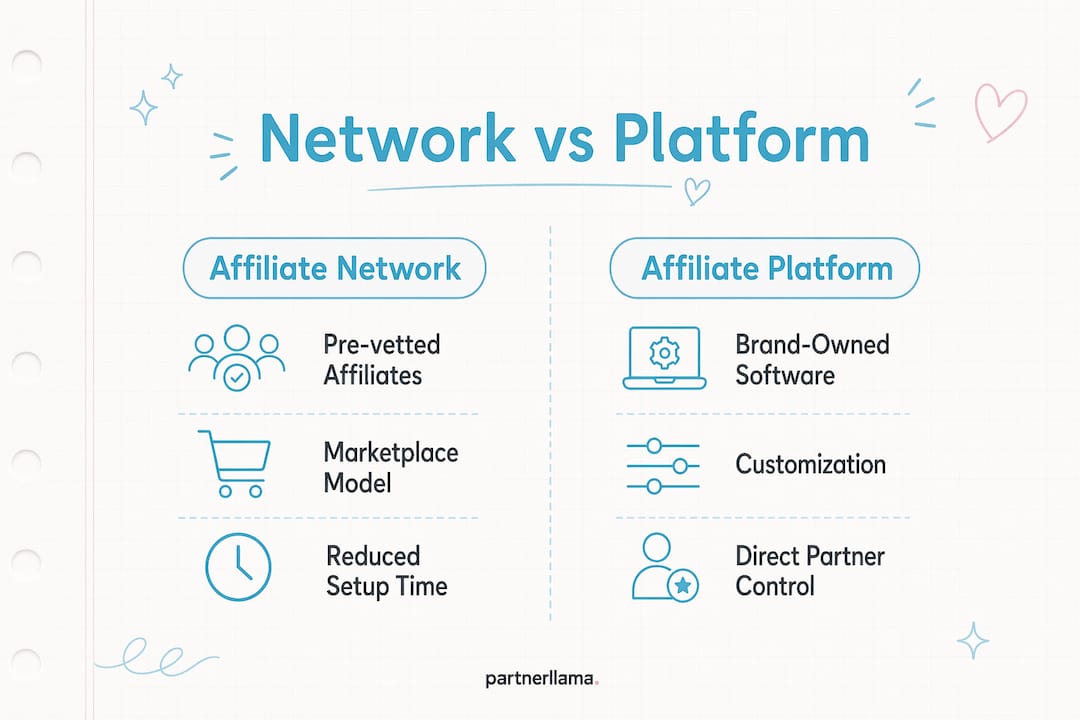
An affiliate network is a marketplace that connects advertisers with a pre-vetted pool of affiliates, while an affiliate platform is software that gives brands direct control over their affiliate program. Understanding what is affiliate network vs platform is one of the most consequential decisions a marketing professional makes when building a partner program. The wrong choice costs money, limits data ownership, and can lock your brand into a relationship you cannot easily exit. The right choice aligns your infrastructure with your growth stage, compliance needs, and long-term revenue goals.
What is affiliate network vs platform: core definitions
An affiliate network acts as an intermediary marketplace. It recruits and vets publishers, manages payouts, handles tracking, and gives advertisers immediate access to a large pool of ready-to-promote partners. Brands pay for that convenience, typically through fees of 20–30% of commission flow or a fixed subscription. That fee covers infrastructure services including fraud screening, attribution, and payout processing.
An affiliate platform, by contrast, is software a brand operates directly. It handles tracking, commission logic, partner communication, and reporting, but the brand owns the relationships and the data. Affiliate software suits brands that need ownership of data and rules, while networks work best when fast access to a large pre-vetted partner pool is the priority. The distinction matters because it determines who controls the program, who owns the affiliate relationships, and how much flexibility you have to grow.

A common misconception is that networks are infrastructure. They are not. Networks are marketplaces primarily built for traffic acquisition. Platforms are the actual infrastructure for managing partner lifecycles. Treating them as interchangeable leads to programs that underperform because the tool does not match the job.
How do affiliate networks and platforms operate differently?
The operational gap between a network and a platform is wider than most marketers expect. Networks are designed for speed and scale. Platforms are designed for control and customization.
What networks handle for you:
- Affiliate recruitment and vetting before you ever log in
- Tracking and attribution using standardized models
- Fraud screening across the publisher pool
- Consolidated payout processing to all affiliates
- Publisher communication through the network's own messaging system
What platforms put in your hands:
- Custom attribution windows and commission structures
- Direct relationships with every affiliate in your program
- Full ownership of affiliate contact data and performance history
- CRM integrations and bespoke reporting
- Configurable onboarding flows and partner tiers
A network-led approach reduces sourcing friction and discovery time. A platform-led approach provides customization for attribution windows, commission structures, and CRM integrations. The tradeoff is real: networks get you running fast, but platforms let you define the rules. For brands that need to set a specific "source of truth" for conversions, standardized network models rarely deliver that precision.
Platforms often require active recruitment unlike plug-and-play network pools. That is the operational cost most brands underestimate. You gain control, but you also take on the work of finding and activating partners yourself.
How do pricing models differ between networks and platforms?
Cost structure is where the network vs platform decision gets concrete. Networks charge in two primary ways: a percentage override on commissions or a flat subscription fee. Networks typically charge 20–30% of commission flow on top of what affiliates earn. On a program paying $50,000 per month in commissions, that override adds $10,000–$15,000 in network fees every month. That compounds fast.
Platforms use tiered subscription pricing. Entry-level plans start at a few hundred dollars per month, with enterprise tiers scaling based on tracked events, integrations, or managed partners. The ongoing fee is lower, but the operational overhead is higher because your team manages more directly.
Key cost considerations when comparing the two:
- Network overrides compound against revenue as your program grows
- Platform subscriptions stay relatively flat regardless of commission volume
- Platforms require internal resources or an agency partner to manage configuration
- Networks bundle fraud screening and payout processing into their fee
- Total cost of ownership on a platform includes staff time, not just software fees
Pro Tip: Calculate total cost of ownership over 24 months, not just the monthly fee. A network that looks cheaper at launch often costs significantly more at scale once commission overrides compound.
Large publisher networks do not automatically improve unit economics. Reaching a broad audience requires complementary custom attribution and integration capabilities that only platforms provide. Paying network fees without those capabilities means you are funding reach without the tools to measure or improve it.
What brands are best suited for networks vs platforms?
The right choice depends on where your brand sits today, not where you hope to be in three years.
Networks work best for brands that:
- Are launching an affiliate program for the first time and need immediate access to publishers
- Have limited internal marketing operations resources
- Sell in categories with large existing publisher communities, such as retail, travel, or consumer software
- Do not have compliance requirements that demand data ownership
Platforms work best for brands that:
- Have an existing affiliate program and want to migrate away from network fees
- Operate in regulated industries where audit trails and data control are non-negotiable
- Need custom commission logic, such as tiered payouts, product-level rates, or lifetime value models
- Want to build a proprietary partner ecosystem with direct relationships
Regulated industries such as iGaming or finance typically require owned affiliate software platforms due to stringent compliance and audit needs. Standard networks cannot support those requirements. This is not a preference issue. It is a legal and operational necessity.
Vendor lock-in is the hidden cost of networks that brands discover too late. Networks act as gatekeepers of communication and payments, limiting program control. When you decide to leave a network, you do not take your affiliate relationships with you. You start over. That reality changes the calculus for any brand thinking about long-term program ownership.
Pro Tip: If you are considering a network, negotiate data portability terms before signing. Most networks will not offer this by default, but some will accommodate it for larger advertisers.
For brands in the affiliate platform selection process, the question is not which option is better in the abstract. It is which option removes the biggest bottleneck in your program right now.
What strategic framework should guide your choice?
The network vs platform decision comes down to two questions: Is your bottleneck partner discovery or program architecture? And do you have the internal resources to manage a platform?
If partner discovery is your constraint, a network solves it immediately. If program architecture, attribution accuracy, or data ownership is your constraint, a platform is the only real answer. A network-led approach can accelerate partner onboarding but limits control over tracking and commissions. A platform-led approach offers control but increases internal operating load.
| Dimension | Affiliate network | Affiliate platform |
|---|---|---|
| Partner discovery | Immediate access to pre-vetted pool | Requires active recruitment |
| Data ownership | Network retains affiliate data | Brand owns all data |
| Commission flexibility | Standardized models | Fully configurable |
| Compliance support | Limited for regulated sectors | Full audit and control capability |
| Cost structure | 20–30% commission override | Tiered subscription fee |
| Vendor lock-in | High | Low |
| Setup speed | Fast | Slower, requires configuration |
A hybrid approach is worth considering for mid-market brands. You can run a platform as your program's core infrastructure while using a network's publisher directory for discovery only. Brands aiming for long-term growth often migrate from networks to platforms as their programs mature. Starting with a network and migrating later is a legitimate path, but plan for it from day one so you are not rebuilding relationships from scratch.
Managing complex commission rules and program customizations is more operationally intensive on platforms but results in stronger program control and partner alignment. That tradeoff is worth it for brands that treat affiliate as a primary revenue channel rather than a supplementary one.
Pro Tip: Audit your current affiliate program's top 20% of partners. If you cannot contact them directly outside the network, you have a vendor lock-in problem worth solving now.
Key Takeaways
The core difference between an affiliate network and an affiliate platform is ownership: networks give you reach, platforms give you control, and the right choice depends entirely on your program's current bottleneck and long-term goals.
| Point | Details |
|---|---|
| Networks provide speed, not control | Use a network when fast access to publishers matters more than data ownership. |
| Platforms require active recruitment | Unlike networks, platforms do not come with a built-in publisher pool. |
| Network fees compound at scale | A 20–30% commission override grows with your program, making platforms cheaper long-term. |
| Regulated industries need platforms | Compliance and audit requirements in finance or iGaming demand owned software, not third-party networks. |
| Vendor lock-in is a real risk | Networks retain affiliate contact data, so leaving means rebuilding relationships from zero. |
The network vs platform decision is not a one-time call
I have watched brands make the same mistake repeatedly: they choose a network because it is fast, then spend two years trying to undo the lock-in once their program starts generating real revenue. The network made sense at launch. It stopped making sense at scale. The problem was not the network. It was the absence of an exit plan.
The brands that build durable affiliate programs treat the network vs platform question as a phased decision, not a permanent one. They start where their resources allow, but they design their program architecture with migration in mind. That means negotiating data terms upfront, documenting affiliate relationships outside the network wherever possible, and tracking which partners drive the most value so you know who to bring with you when you move.
The other thing I see underestimated is the operational load of platforms. Marketers read "full control" and hear "easy." Full control means your team configures attribution logic, manages onboarding flows, handles partner communication, and troubleshoots tracking discrepancies. That is real work. For brands without dedicated affiliate operations resources, a platform without expert support is a tool that sits underused.
The 2026 affiliate market is moving toward owned program infrastructure. Brands that built on networks alone are finding their unit economics squeezed by fees and their growth capped by standardized attribution models. The shift is not about networks being bad. It is about platforms becoming accessible enough that the control they offer is worth the operational investment for a wider range of brands.
My honest advice: if you are generating more than $20,000 per month in affiliate commissions, the math on a platform almost always wins. If you are below that threshold, a network's plug-and-play model is probably the right starting point. The key is knowing which phase you are in and building toward the next one.
— Isabel
How PartnerLlama builds affiliate programs that work at every stage
Whether you are running a network-based program or managing your own platform, the gap between setup and performance is where most brands lose revenue.

PartnerLlama manages the full partner lifecycle, from recruitment and onboarding through activation, retention, and long-term performance. For brands on affiliate platforms, PartnerLlama handles the operational complexity of commission and payout management, custom attribution setup, and partner communication. For brands using networks, PartnerLlama layers in lifecycle email marketing to convert affiliate-driven traffic that networks alone cannot capture. The result is a program built for sustainable revenue, not just traffic volume. If your affiliate program is not performing at the level your investment deserves, PartnerLlama builds the system that changes that.
FAQ
What is the main difference between an affiliate network and a platform?
An affiliate network is a marketplace that connects brands with pre-vetted publishers and manages payouts on their behalf. An affiliate platform is software the brand operates directly, giving full ownership of data, relationships, and commission logic.
How do affiliate networks make money?
Networks typically charge advertisers a fee of 20–30% of commission flow, or a fixed subscription, in exchange for tracking, fraud screening, and payout processing services.
Can a brand use both a network and a platform at the same time?
Yes. A hybrid approach uses a platform as the core program infrastructure while tapping a network's publisher directory for partner discovery. This gives brands reach without surrendering full program control.
What happens to affiliate relationships when a brand leaves a network?
Networks retain affiliate contact data and communication history. When a brand exits, it loses direct access to those relationships and typically must rebuild its publisher base from scratch.
Which option is better for a regulated industry like finance or health?
Regulated sectors require owned affiliate platforms because compliance, audit trails, and data control demands exceed what standard networks can provide.