

Affiliate link management is the structured practice of creating, tracking, branding, and optimizing the unique URLs that connect your partners to your products and revenue. The global affiliate market is projected to reach $42.6 billion in 2026, which means the brands with clean, centralized link systems will capture a disproportionate share of that growth. Affiliate link management basics cover everything from how tracking redirects work to how you attribute commissions, monitor partner performance, and stay compliant with privacy regulations. Get this foundation right, and every other part of your affiliate program management becomes measurably easier.
What are the core tools for affiliate link management?
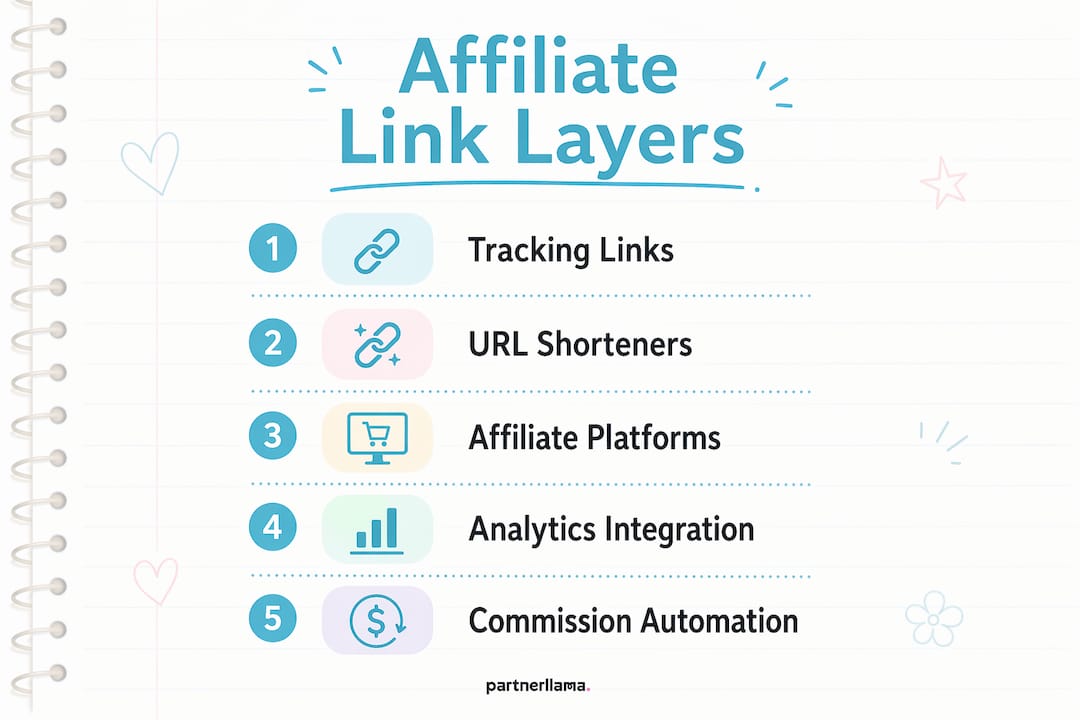
Affiliate link management sits on three technical layers: tracking links, URL shorteners, and affiliate platforms. Each layer serves a distinct function, and skipping any one of them creates gaps in your attribution data.
Tracking links are the backbone of the system. Link tracking happens at the redirect layer, capturing click data before the visitor ever reaches your destination page. This means you do not need admin access to the destination site to track performance, which is critical when your affiliates are sending traffic to third-party landing pages or co-branded microsites.

URL shorteners and branded links handle the presentation layer. Redirects execute in under 50 milliseconds, so branded links like "brand.co/partner-name` preserve click data without slowing the user experience. Clean, branded links also perform better in social posts and email campaigns because they look trustworthy rather than like raw tracking strings.
Affiliate platforms and dashboards are where commission logic, payout automation, and partner reporting live. Tools like Impact, PartnerStack, and ShareASale handle the operational layer: assigning unique affiliate IDs, calculating commissions, and triggering payouts. Integrating your affiliate platform with Google Analytics 4 (GA4) closes the loop between click data and on-site conversion events.
| Tool Layer | Primary Function | Example Tools |
|---|---|---|
| Tracking links | Capture pre-arrival click data | Bitly, Pretty Links, custom redirects |
| Affiliate platforms | Commission logic and payout automation | Impact, PartnerStack, ShareASale |
| Analytics integration | Post-arrival conversion attribution | GA4, Segment |
| URL shorteners | Branded, clean link presentation | Rebrandly, Bitly |
Pro Tip: Always integrate your affiliate platform with GA4 before you recruit your first partner. Retrofitting analytics after launch forces you to reconcile months of mismatched data.
How to set up and organize affiliate links for accurate tracking
Accurate attribution starts with a deliberate link creation workflow. Skipping steps here is the single most common reason affiliate programs produce unreliable data.
-
Assign unique affiliate IDs. Every partner gets a unique identifier in your affiliate platform. This ID is embedded in the tracking link and is what ties a click to a specific partner's commission. Cookie windows for these IDs typically range from 24 hours to 90 days, so choose your window based on your average sales cycle. A SaaS product with a 30-day trial needs a longer window than a direct-to-consumer impulse purchase.
-
Build UTM parameters before shortening. UTM parameters provide post-arrival attribution while tracking links handle the pre-arrival click context. The correct order is: build your destination URL, append UTM parameters, then run the full string through your shortener or branded link tool. Reversing this order strips UTMs after the redirect and breaks your GA4 reports.
-
Enforce a consistent UTM taxonomy. Consistent naming conventions prevent "data decay," which is what happens when one affiliate uses
utm_source=emailand another usesutm_source=Emailand a third usesutm_source=newsletter. GA4 treats these as three separate sources. Build a shared UTM naming doc and require every partner to use it. -
Apply link cloaking where appropriate. Cloaking replaces raw affiliate tracking strings with clean branded URLs. This protects your brand from link hijacking, keeps messaging consistent across partner content, and prevents raw commission parameters from appearing in browser bars. Tools like Pretty Links or your affiliate platform's built-in cloaking handle this automatically.
-
Document every link in a central registry. A simple spreadsheet or your affiliate platform's link library should record the destination URL, the partner it belongs to, the UTM parameters used, the creation date, and the campaign it supports. This registry becomes your audit trail when attribution disputes arise.
Pro Tip: Create a link template in a shared Google Sheet with pre-filled UTM fields. Partners copy the template, fill in their ID, and the URL builds automatically. This eliminates taxonomy errors at the source.
What are the most common affiliate link management mistakes?
Unmanaged affiliate links cause low-quality traffic, inconsistent branding, and regulatory exposure. These are not edge cases. They are the default outcome when programs scale without a link governance process.
The most damaging mistakes fall into four categories:
- Inconsistent UTM usage. When partners create their own UTMs without a shared taxonomy, your analytics reports fragment into dozens of unrecognizable sources. You lose the ability to compare partner performance or identify which campaigns drive real revenue.
- Ignoring cookie consent and GDPR requirements. Cookie-based tracking requires explicit user consent in the EU and increasingly in US states under laws like the California Consumer Privacy Act (CCPA). Failing to surface a compliant consent banner before dropping affiliate cookies exposes your brand to regulatory risk. Your affiliate partner agreements should explicitly address data handling obligations.
- No fraud detection process. Click stuffing, cookie dropping, and fake conversions inflate affiliate payouts without generating real revenue. Monitoring for anomalies like sudden click spikes from a single IP range or conversion rates that are statistically impossible is a non-negotiable part of program health.
- Manual communication and reporting. Programs that rely on email threads to share performance data lose partners to programs that provide real-time dashboards. Automated reporting is a retention tool, not just an operational convenience.
"Affiliate link management encompasses more than tracking. It ensures brand safety, messaging consistency, and compliance, all of which are critical to program growth." — monday.com Affiliate Management Guide
Compliance and brand safety are not separate concerns from link management. They are built into it. Every link your partners deploy is a brand touchpoint, and every unmonitored touchpoint is a liability.
How can performance monitoring maximize your affiliate program ROI?
Basic click tracking is insufficient for measuring real ROI. The metric that matters is the conversion event tied to a click, not the click itself. Advanced link tracking connects clicks to purchases, sign-ups, and lifetime value across sessions and devices, which is the only way to know which partners are actually driving revenue.
The monitoring framework that works looks like this:
| Metric | What It Measures | Why It Matters |
|---|---|---|
| Click-to-conversion rate | Quality of partner traffic | Separates high-intent audiences from low-quality clicks |
| Revenue per click (RPC) | Earnings efficiency per partner | Identifies top performers for tiered commission offers |
| Cookie window utilization | How long buyers take to convert | Informs optimal attribution window settings |
| Payout-to-revenue ratio | Commission cost as % of revenue | Flags unsustainable commission structures early |
Dashboards that compare affiliate tiers side by side reveal performance gaps that aggregate reports hide. A partner sending 10,000 clicks at a 0.1% conversion rate is less valuable than one sending 500 clicks at a 4% conversion rate. Sorting by RPC rather than raw click volume reorients your entire optimization strategy.
AI-assisted tools are now embedded in platforms like Impact and PartnerStack for fraud detection and performance forecasting. These tools flag statistical anomalies in real time rather than waiting for a monthly audit. For brands scaling past 50 active affiliates, affiliate tracking technology that includes automated anomaly detection is no longer optional.
Automated payout triggers tied to verified conversion events also serve a retention function. Partners who receive accurate, on-time payments stay active. Partners who chase down payment inquiries leave for programs with better infrastructure.
Pro Tip: Set a monthly "link audit" calendar event. Review your top 20 affiliate links for broken redirects, expired UTMs, and conversion rate anomalies. Thirty minutes of proactive monitoring prevents weeks of attribution cleanup.
Key takeaways
Effective affiliate link management requires a unified system of tracking links, consistent UTM taxonomy, and conversion-level monitoring to produce reliable attribution and sustainable partner revenue.
| Point | Details |
|---|---|
| Tracking happens before arrival | Link redirects capture click data at the redirect layer, requiring no destination page access. |
| UTMs must be built before shortening | Appending UTMs after shortening strips attribution data from GA4 reports. |
| Cookie windows affect attribution accuracy | Choose a 24 to 90-day window based on your product's actual sales cycle length. |
| Compliance is part of link management | GDPR and CCPA requirements apply to cookie-based tracking and must be addressed in partner agreements. |
| Conversion tracking beats click counting | Revenue per click and click-to-conversion rate are the metrics that reveal true partner value. |
Why most affiliate programs underperform at the link level
I have reviewed affiliate programs across DTC, SaaS, and health and wellness brands, and the pattern is almost always the same. The program has decent partners and a reasonable commission structure, but the link layer is a mess. UTMs are inconsistent, cookie windows were set arbitrarily, and nobody has audited the link registry in six months.
The uncomfortable truth is that most affiliate program underperformance is a data problem before it is a partner problem. When you cannot trust your attribution, you cannot make good decisions about who to pay more, who to cut, or which campaigns to scale. You end up rewarding the loudest partners rather than the most effective ones.
What I have found actually works is treating link management as a product, not a task. Build a link creation workflow that partners follow, not one that you hope they follow. Automate the UTM taxonomy. Set up anomaly alerts before you need them. And review your affiliate audience alignment regularly, because a partner whose audience no longer matches your buyer profile will show up as declining RPC long before they tell you they are not converting.
The brands that will capture the most value from the affiliate channel as it grows toward $42.6 billion are the ones treating link infrastructure as a competitive advantage. Clean data compounds. Messy data costs you money every month you ignore it.
— Isabel
How PartnerLlama builds affiliate link systems that scale

PartnerLlama manages the full affiliate program lifecycle, including the link infrastructure that most agencies leave to their clients to figure out. From branded link setup and UTM taxonomy design to conversion tracking integration and automated partner reporting, PartnerLlama builds the operational layer that turns affiliate programs into reliable revenue channels.
For DTC brands and SaaS companies scaling past their first cohort of partners, PartnerLlama's affiliate marketing management service covers link governance, fraud monitoring, payout automation, and performance dashboards. You get a program that runs on clean data and keeps partners engaged long-term. If your current affiliate link setup is producing unreliable attribution or inconsistent partner results, contact PartnerLlama to build a system that actually scales.
FAQ
What is affiliate link management?
Affiliate link management is the process of creating, tracking, branding, and optimizing the unique URLs assigned to affiliate partners. It covers attribution setup, UTM taxonomy, compliance, and performance monitoring across the full partner program.
How long should affiliate cookie windows be?
Cookie windows range from 24 hours to 90 days depending on your product's sales cycle. Short-cycle consumer products typically use 24 to 30-day windows, while SaaS or considered purchases benefit from 60 to 90-day attribution periods.
What is the difference between link tracking and UTM parameters?
Link tracking captures pre-arrival data at the redirect layer before the visitor reaches your site, while UTM parameters provide post-arrival attribution inside GA4. Both are required for complete performance measurement.
Why do affiliate links need to be cloaked?
Link cloaking replaces raw tracking strings with clean branded URLs, which protects against link hijacking, maintains brand consistency across partner content, and prevents commission parameters from appearing in browser address bars.
How do you detect affiliate link fraud?
Monitor for statistical anomalies including sudden click spikes from narrow IP ranges, conversion rates above realistic benchmarks, and payout-to-revenue ratios that spike without a corresponding increase in verified sales. Platforms like Impact and PartnerStack include built-in fraud detection tools for automated monitoring.