

An affiliate commission structure is the framework that defines how and how much affiliates earn for promoting your products or services. It covers payment models, rate calculations, and payout timing. Getting this framework right determines whether your affiliate program attracts serious partners or sits dormant. Platforms like Shopify Collabs and Impact have built entire ecosystems around these structures, which tells you how central commission design is to affiliate marketing success. This guide breaks down every major model, real industry benchmarks, and the tracking mechanics that affect every payout.
What is affiliate commission structure and how does it work?
An affiliate commission structure is the set of rules governing how affiliates get paid for each action they drive, whether that is a sale, a lead, or a click. The structure specifies the payment model, the rate, the attribution method, and the payout schedule. Without a defined structure, affiliates cannot evaluate whether your program is worth promoting.
How affiliate commission works starts with a tracked link. When a visitor clicks that link and completes a qualifying action, the affiliate earns a commission based on the rules you set. The action, the rate, and the timing are all variables you control as the program owner.

The structure you choose signals your priorities to potential partners. A flat-rate model signals simplicity. A tiered model signals that you reward performance. A recurring model signals that you value long-term relationships. Each choice attracts a different type of affiliate.
What are the main types of affiliate commission structures?
Seven primary commission models exist in affiliate marketing, with Pay-Per-Sale being the most common in e-commerce. Each model fits a different business type and goal.
- Pay-Per-Sale (PPS): The affiliate earns a percentage or flat fee when a referred visitor makes a purchase. This is the default model for most e-commerce brands and is straightforward to track and manage.
- Pay-Per-Lead (PPL): The affiliate earns a commission when a visitor completes a defined action, such as signing up for a free trial or filling out a contact form. SaaS companies favor this model because it aligns with their sales funnel.
- Pay-Per-Click (PPC): The affiliate earns a small fee for each click generated, regardless of conversion. This model is rare in affiliate programs today because it is easy to game and offers poor ROI for advertisers.
- Recurring Commissions: The affiliate earns a percentage of every subscription renewal, not just the first sale. This model is the gold standard for SaaS and subscription businesses because it rewards affiliates for driving retained customers.
- Tiered Commissions: Affiliates move into higher rate brackets as they hit performance milestones. A three-tier structure might pay Bronze affiliates 5%, Silver affiliates 10%, and Gold affiliates 20%.
- Flat-Rate Commissions: The affiliate earns a fixed dollar amount per conversion, regardless of order value. This works well for high-ticket products with predictable margins.
- Hybrid Models: A hybrid structure combines two payment types, such as a $50 cost-per-acquisition bonus plus a 15% recurring commission. This balances short-term recruitment incentives with long-term earnings.
Pro Tip: Start with a simple Pay-Per-Sale or flat-rate model when launching your program. Add tiered or hybrid structures only after you have enough performance data to set meaningful thresholds.
What are typical affiliate commission rates by industry?
Commission rates vary significantly by industry, and benchmarking yours against sector norms is the fastest way to assess your program's competitiveness. Rates across sectors break down as follows: e-commerce pays 5–20%, SaaS pays 20–40% recurring, and digital products pay 30–60%. That spread reflects the margin differences between physical goods, software, and information products.
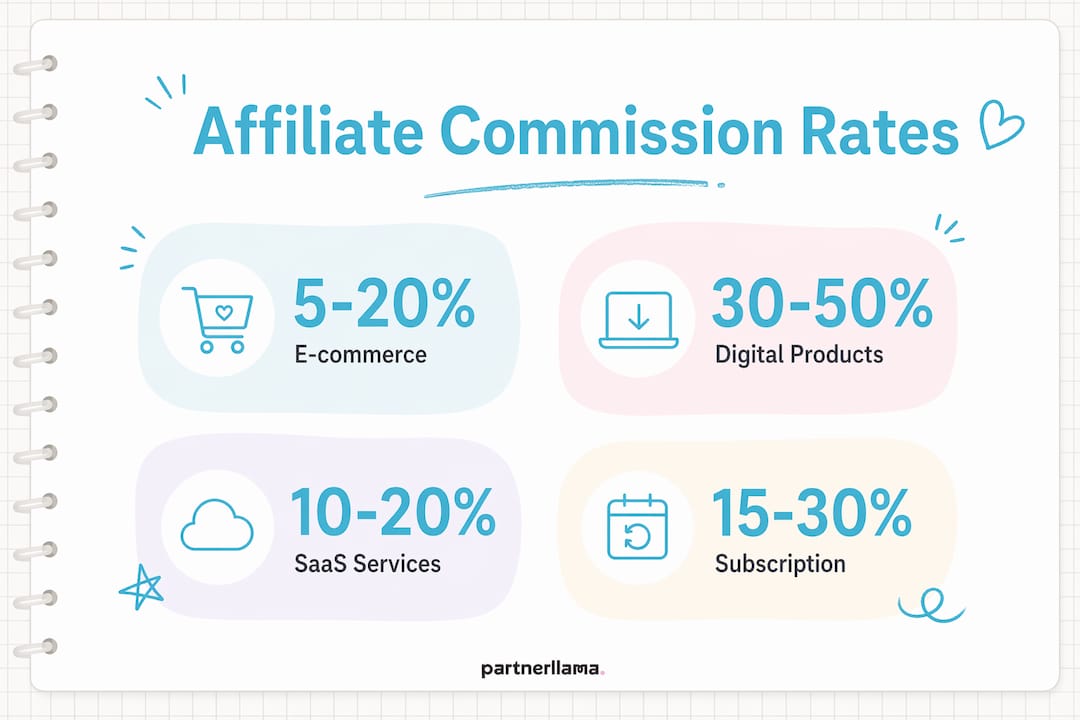
| Industry | Typical Commission Range | Common Model |
|---|---|---|
| E-commerce | 5–20% per sale | Pay-Per-Sale |
| SaaS | 20–40% recurring | Recurring |
| Digital Products | 30–60% per sale | Pay-Per-Sale or flat-rate |
| Finance / Insurance | $50–$200 per lead | Pay-Per-Lead |
| Travel | 3–10% per booking | Pay-Per-Sale |
Digital products command the highest rates because their cost of delivery is near zero. A course creator paying 50% commission still keeps half of every sale with no inventory or shipping cost. E-commerce brands operate on thinner margins, so rates below 10% are common and financially necessary.
Balancing affiliate motivation with profitability requires knowing your customer lifetime value and average order value before setting a rate. If your average order value is $80 and your gross margin is 40%, a 20% commission leaves you $16 per sale after paying the affiliate. That math has to work before you publish a rate. Use a marketing ROI framework to verify your numbers before committing to a rate publicly.
How do cookie windows, attribution, and payout timing affect commissions?
The mechanics behind commission tracking determine whether affiliates get paid accurately and whether your program builds trust over time. Three variables matter most: cookie duration, attribution model, and payout timing.
-
Cookie window duration. A cookie window is the period during which an affiliate gets credit for a conversion after a visitor clicks their link. Cookie windows range from 24 hours to one year, with 30 days being the most common standard. Amazon Associates uses a 24-hour window, which frustrates affiliates promoting high-consideration purchases. A 30-day or 60-day window is more competitive for most product categories.
-
Attribution model. Last-click attribution is the industry default, meaning the affiliate whose link was clicked most recently before purchase receives full credit. Multi-touch attribution exists but is complex and rare in affiliate programs. If you run paid search alongside your affiliate program, last-click attribution can strip commissions from affiliates when your own ads intercept the final click.
-
Payout timing. Commission payouts are held for 30–60 days to account for refunds and chargebacks before approval. That delay protects your business from paying commissions on returned orders, but it can frustrate new affiliates expecting faster payment. Communicate this timeline clearly in your program terms.
Pro Tip: Document your cookie window, attribution model, and payout schedule in your affiliate agreement before recruiting partners. Affiliates who discover these terms after joining are more likely to leave or underperform.
Tracking accuracy also depends on the affiliate tracking technology you use. Server-side tracking is more reliable than cookie-based tracking because it is not affected by browser privacy settings or ad blockers.
What strategies help you optimize commission structures for growth?
Designing a commission structure that scales requires moving beyond a single flat rate. Flexible commission structures that adjust based on real-time metrics like customer lifetime value produce better program outcomes than static volume-based models. That shift from "how many sales" to "what kind of sales" is what separates growing programs from stagnant ones.
Here are the strategies that produce the most consistent results:
- Build tiered incentives around meaningful thresholds. Set performance tiers based on your actual affiliate data. If your top 10% of affiliates drive 60% of revenue, design your Gold tier to capture that group and reward them accordingly.
- Add performance bonuses for high-value behaviors. Bonuses for driving first-time customers, promoting specific product lines, or hitting seasonal targets give affiliates a reason to stay active between standard commission cycles.
- Align recurring commissions with retention goals. Programs that use tiered and recurring models sustain affiliate engagement longer than flat-rate programs. An affiliate earning monthly recurring revenue has a financial reason to keep promoting your product.
- Adopt affiliate management software early. Managing complex structures manually leads to calculation errors and partner disputes. Tools like Impact, PartnerStack, and Refersion handle tiered payouts, performance tracking, and automated payments at scale.
- Review and adjust rates quarterly. Commission rates that made sense at launch may underperform as your competitive landscape shifts. Build a quarterly review into your program calendar.
For brands scaling beyond basic affiliate recruitment, advanced expansion tactics like co-marketing partnerships and ambassador tiers can layer on top of your core commission structure to drive incremental revenue.
Key takeaways
The most effective affiliate commission structure combines a competitive base rate, performance-based tiers, and transparent tracking mechanics to attract and retain high-quality partners.
| Point | Details |
|---|---|
| Choose the right model first | Match your commission type to your business model: PPS for e-commerce, recurring for SaaS, PPL for lead-gen. |
| Benchmark rates by industry | E-commerce pays 5–20%, SaaS 20–40% recurring, and digital products 30–60% per sale. |
| Cookie windows affect partner trust | A 30-day window is the standard; shorter windows reduce affiliate competitiveness and partner satisfaction. |
| Payout holds protect your margins | Hold commissions for 30–60 days to cover refund risk, and communicate this clearly in your program terms. |
| Use software before you need it | Manual tracking of tiered or hybrid models causes errors; adopt affiliate management tools before your program scales. |
Why most affiliate programs get commission design wrong
I have reviewed dozens of affiliate programs across e-commerce, SaaS, and digital products, and the same mistake shows up repeatedly. Brands set a commission rate by looking at what competitors pay, not by working backward from their own unit economics. That approach produces rates that are either too low to attract serious affiliates or too high to sustain profitability past the first quarter.
The second mistake is launching a tiered structure without enough affiliate volume to populate the tiers. If you have 30 affiliates and your Gold tier requires 100 sales per month, that tier is decorative. Tiers only motivate behavior when they are reachable.
The third mistake is treating cookie windows and attribution as technical footnotes. Affiliates who understand tracking mechanics will test your program before committing to it. A 24-hour cookie on a product with a two-week consideration cycle tells experienced affiliates that your program is not worth their time.
What actually works is starting simple, measuring everything, and adding complexity only when your data justifies it. A flat-rate Pay-Per-Sale model with a 30-day cookie and a clear payout schedule will outperform an elaborate tiered structure with opaque tracking every time. Build trust with your affiliates first. The sophisticated commission design comes after you have partners worth designing for.
— Isabel
Build a commission structure that actually performs
Getting your commission structure right is one thing. Managing it at scale, across dozens or hundreds of partners, with accurate tracking and on-time payouts, is where most programs break down.

PartnerLlama builds and manages complete affiliate programs, from commission design and partner onboarding to performance tracking and automated payout management. If your current program is underperforming or you are building from scratch, PartnerLlama's team handles the full lifecycle so your commissions drive real revenue. Explore affiliate program management built for DTC and SaaS brands that need results, not just activity.
FAQ
What is an affiliate commission structure?
An affiliate commission structure is the framework that defines how affiliates are paid for driving sales, leads, or other actions. It includes the payment model, rate, attribution method, and payout schedule.
What are the most common types of affiliate commissions?
The seven main types are Pay-Per-Sale, Pay-Per-Lead, Pay-Per-Click, recurring commissions, tiered commissions, two-tier programs, and flat-rate models. Pay-Per-Sale is the most widely used model in e-commerce.
How do i calculate affiliate earnings?
Multiply the commission rate by the sale value, or apply the fixed flat-rate amount per conversion. For tiered programs, apply the rate corresponding to the affiliate's current performance bracket.
What is a standard cookie window for affiliate programs?
The standard cookie window is 30 days, though programs range from 24 hours to one year depending on the product's sales cycle complexity.
How long does it take to receive an affiliate commission payout?
Most programs hold commissions for 30–60 days to account for refunds and chargebacks before releasing payment to affiliates.